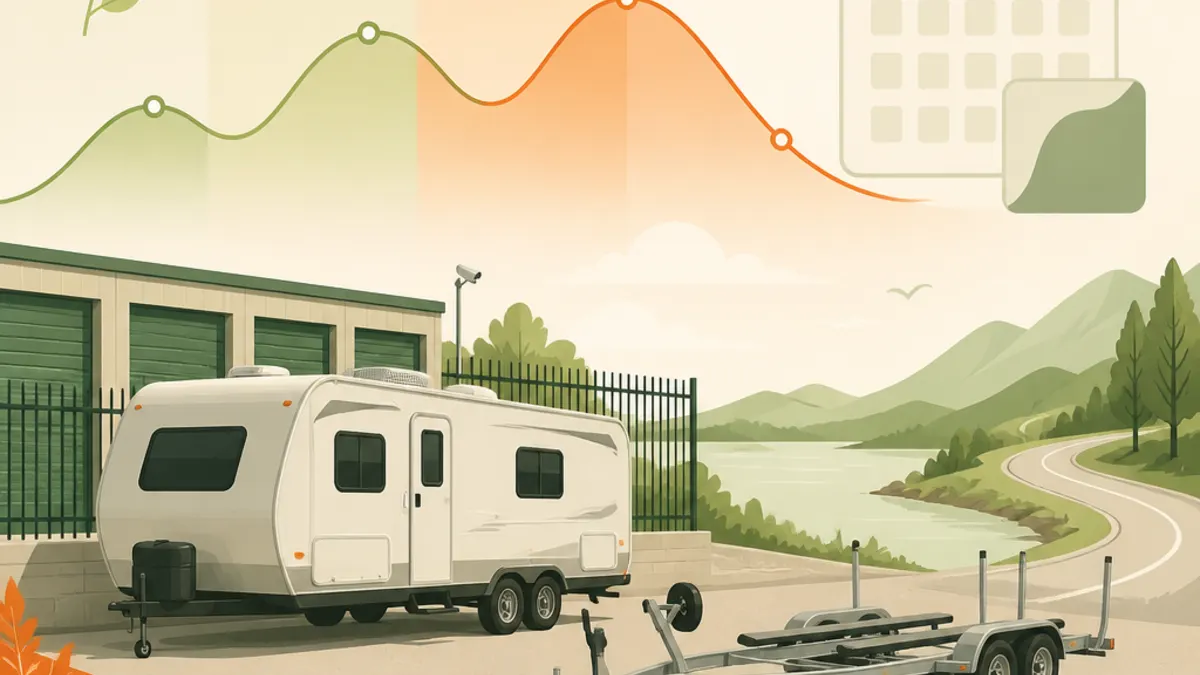
RV, boat, and trailer storage demand tends to run more seasonal than general household storage in most markets -- heavier around travel season, lighter in the off-season. That seasonality changes how you should think about pricing and occupancy expectations compared to a standard garage or closet listing, where demand is comparatively steady year-round. This article covers what actually drives RV storage demand, how pricing and access work differently for large vehicles, and how to model a realistic full year rather than extrapolating from one strong month.
This assumes you understand basic Neighbor host economics from the Neighbor.com host earnings guide and want the RV/large-vehicle-specific version of that business.
What Actually Drives Demand for RV and Boat Storage
Three factors explain most of the demand variation for this space type.
Proximity to travel routes or bodies of water. RV storage demand correlates with proximity to popular travel routes and destinations; boat storage demand correlates specifically with proximity to lakes, rivers, or coastline. A space near a major RV travel corridor or a popular boating lake taps into real, location-specific demand that a space in neither situation simply doesn't have access to.
HOA restrictions pushing owners off-site. Many residential areas and homeowners associations restrict or prohibit parking RVs, boats, and trailers on residential property. Owners who love these hobbies but live somewhere with that restriction need off-site storage -- and that need is often the entire reason this market exists in a given area. Check whether your local area has meaningful HOA restriction density; it's a strong demand signal.
Seasonal usage patterns. Owners use RVs and boats during travel/boating season and need storage the rest of the year -- the opposite pattern from someone storing household overflow, whose need doesn't follow a calendar. This creates the defining characteristic of this space type: strong demand in the off-season for the vehicle (storage), and often near-zero demand during the vehicle's use season (the owner has it out being used, not stored).
How Pricing Works for This Space Type
Pricing logic differs meaningfully from a standard storage listing.
Per-length or per-square-foot pricing. RV, boat, and trailer storage is often priced by vehicle length or by square footage rather than a single flat rate per space, because the size range within this category is enormous -- a small camper and a large motorhome have vastly different footprints and shouldn't command the same price. Per-length pricing means calculating a rate per linear foot and multiplying by the specific vehicle's length, which is closer to how renters in this category expect to be quoted.
Why this matters for your listing structure. If your space can accommodate a range of vehicle sizes, presenting a single flat rate either overprices smaller vehicles (losing that segment of demand) or underprices larger ones (leaving money on the table). A length- or footage-based rate captures the right price across the range you can actually accommodate.
Research local per-length comparables. Search local RV and boat storage listings specifically -- not general storage comparables, which follow different pricing logic -- for typical per-foot or per-square-foot rates in your market. The storage space pricing calculator can model this once you have real comparable data to input.
Access and Space Requirements That Differ From Standard Storage
Large vehicles need considerations a garage or closet listing never has to address.
Turning radius. Turning radius is the space a vehicle needs to maneuver into and out of a parking position. Large RVs and boat trailers need considerably more maneuvering room than a car does, and a space that's technically long enough but too tight to actually turn into is unusable regardless of its raw dimensions. Measure and describe the actual approach and turning space, not just the parking footprint.
Surface type suitable for vehicle weight. A heavy RV or boat trailer needs a surface that can support its weight without sinking, rutting, or degrading over time -- gravel, concrete, or compacted surfaces suited to the load, not standard grass or soft ground. Surface type is a real cost and durability consideration if you're developing a space specifically for this use, and it's worth researching materials genuinely rated for heavy vehicle weight rather than assuming any hard surface works.
Gate and access hour considerations. Because these vehicles are typically retrieved for trips rather than daily use, access patterns differ from household storage -- renters may need access for extended pickup and return windows around trips rather than frequent quick visits. Clarify your gate hours and access process with this usage pattern in mind, since a renter loading up for a weekend trip needs a genuinely workable access window, not just technical availability.
The Space Requirements Checklist
Confirm all of these before marketing a space for RV, boat, or trailer storage:
- Measure actual usable length and width, not just the parking footprint.
- Confirm turning radius for the largest vehicle size you intend to market to.
- Verify surface type can support the weight of RVs, trailers, or boat-and-trailer combinations without degrading.
- Document gate hours and access process, accounting for trip-based pickup and return patterns.
- Check for low overhangs, trees, or obstacles that could restrict access for taller vehicles.
- Confirm any local HOA or zoning restrictions on your own property don't conflict with hosting this use.
- Assess security features appropriate to the vehicle values you'll be storing (see below).
How Seasonality Should Shape Your Occupancy Expectations
This is the defining operational difference from general storage hosting, and it deserves real modeling rather than a passing acknowledgment.
Unlike household storage, where demand is comparatively steady year-round, RV and boat storage typically sees a clear seasonal curve: strong occupancy during the off-season (when owners need somewhere to put the vehicle) and weaker occupancy during peak use season (when the vehicle is out being used, not stored). This is close to the inverse of what a new host might intuitively expect -- your "slow season" for this space type is often exactly when the underlying hobby is at its most active.
Model a full year, not a single strong month. A host who prices and projects off their space's first month -- often, coincidentally, launched right as off-season storage demand peaks -- can badly overestimate annual income if they don't account for the coming use-season dip. Build your revenue projection across all twelve months using a realistic seasonal curve for your specific market and vehicle type, not a flat extrapolation of your best month.
Regional variation is significant. The specific timing and severity of the seasonal swing depends heavily on your local climate and the local RV/boating culture -- validate this locally rather than assuming a generic curve applies to your market.
Worked Example One: RV Storage in a Travel-Heavy Market
A driveway space in a market with strong regional RV travel culture and meaningful HOA restriction density nearby.
The seasonal pattern: strong occupancy through the off-season months as regional RV owners need winter (or off-travel-season) storage, tapering as travel season approaches and owners retrieve their vehicles, with a clear dip through peak travel months, then ramping back up as the season ends and vehicles come back for storage.
The modeling approach: rather than assuming the strong off-season months represent typical performance, project the full year using a realistic seasonal curve -- high occupancy for the off-season stretch, low occupancy through the travel-heavy months, with transition months in between. Average annual occupancy will land well below the off-season peak, and that blended, full-year figure is the number that should drive your income expectations, not the peak month.
The pricing implication: because demand concentrates in a predictable window, some hosts price at a premium during peak-demand storage months (right before and after travel season) and hold or lightly discount during the shoulder period to smooth occupancy, similar in spirit to how STR hosts manage seasonal pricing.
The read: an RV storage host in this kind of market should expect a genuinely seasonal income pattern, not a flat monthly figure, and should budget and plan around the full-year blended average rather than the best month's number.
Worked Example Two: Boat Storage Near a Popular Waterway
A side-yard space near a popular lake with active recreational boating.
The demand driver: proximity to the specific waterway is doing most of the work here -- boat storage demand is far more geographically concentrated than RV storage demand, since it depends on closeness to water rather than a broader travel corridor.
The seasonal pattern: similar inverse logic to the RV example -- strong storage demand outside the boating season, weak demand during it, since owners have their boats out on the water rather than in storage during peak season. The specific months shift based on regional climate (a warm-climate boating season runs longer than a cold-climate one), which is exactly the kind of detail to validate locally rather than assume.
What's different from the RV case: boat storage demand is more narrowly tied to a single, specific local amenity (this particular waterway) than RV storage's broader travel-corridor demand. A location's boat-storage viability depends almost entirely on genuine proximity and access to water-based recreation -- a location without that nearby amenity has essentially no boat storage demand, regardless of how well the space itself is set up.
The read: validate the specific local waterway's boating culture and demand density before assuming boat storage viability, even more so than for RV storage, since the demand driver here is narrower and more geographically concentrated.
Security and Liability Considerations for High-Value Vehicles
RVs and boats typically represent much higher individual value than the household items in a standard storage listing, which raises the stakes on both security and liability.
Security proportional to value. A camera covering the access point (disclosed, per the standard practice covered in Neighbor host security camera setup) matters more here than for a garage of boxes, given what's typically at stake. Gated access, good lighting, and a secured perimeter are worth investing in proportional to the vehicle values you're hosting.
Liability exposure is meaningfully higher. An RV or boat represents a much larger potential loss than typical household storage contents, which raises the liability question significantly. Neighbor host insurance coverage explains platform protection generally, but it's worth specifically confirming whether coverage limits are adequate relative to the vehicle values you expect to store -- a host guarantee's cap may fall well short of a boat or RV's actual worth, a gap that matters far more here than it would for a garage of furniture.
Condition documentation matters more. Photograph the space's condition and, where reasonable, encourage or require renters to document their vehicle's condition at drop-off, given the higher stakes if a dispute arises over damage.
Common Mistakes
Pricing without accounting for seasonal demand swings. The most common and costly mistake specific to this space type. A host who prices and projects based on a strong off-season month, without modeling the coming use-season dip, is set up for an unpleasant surprise when occupancy drops as travel or boating season arrives. Model the full year from the start.
Not confirming the space actually accommodates the vehicle sizes marketed. Listing a space as suitable for "RVs" broadly without confirming turning radius and length for the actual range of vehicles that might inquire. A mismatch discovered on move-in day is a bad experience for everyone and a preventable one.
Underestimating liability exposure. Treating this like standard storage hosting from an insurance and security standpoint, when the vehicle values involved are typically far higher. Confirm coverage limits are adequate for what you're actually storing, not just assume standard protection covers it.
Ignoring surface durability. Repeatedly parking heavy vehicles on a surface not rated for that weight leads to degradation over time, which is a real maintenance cost that erodes the economics if not planned for upfront.
Assuming demand exists without checking local RV/boating culture. As covered in the "when this isn't a good fit" section below, this space type depends entirely on local demand drivers that don't exist everywhere.
When This Space Type Isn't a Good Fit
Be honest about the disqualifying case: in a market without significant nearby RV or boating culture, general household storage demand may actually outperform a specialized RV or boat listing on the same square footage.
This space type's demand depends entirely on proximity to travel routes, water, or a meaningful local population of RV and boat owners facing HOA restrictions. Without those specific local conditions, there's simply no demand pool for this specialized use, regardless of how well the space is set up. In that situation, the same square footage marketed as general storage -- tapping into the more universal demand for household overflow -- likely performs better than a specialized listing chasing a demand pool that doesn't meaningfully exist locally.
Validate this before committing space or investment to RV-specific setup (surface work, turning-radius accommodation): check for existing local RV/boat storage listings and their apparent occupancy, research nearby travel routes or waterways, and honestly assess local HOA restriction density. If those signals are thin, a self storage host diversification strategy built around more universal household demand, or a driveway rental income guide approach targeting general vehicle storage, may be the better use of the same space.
Frequently Asked Questions
How much does RV storage income vary by season?
Significantly in most markets -- expect strong off-season occupancy and a real dip during peak travel or boating season, the inverse of a flat year-round pattern. The specific magnitude and timing depend on your regional climate and local RV/boating culture, so model your own market's curve rather than assuming a generic seasonal pattern applies.
What if a renter's vehicle doesn't actually fit the space as measured?
This is why precise measurement and clear communication upfront matter so much -- confirm exact vehicle dimensions against your space's actual usable length, width, and turning radius before accepting a booking, not after the vehicle arrives. If a mismatch occurs despite this, address it immediately and directly with the renter rather than allowing an unsafe or damaging fit; this is also a strong argument for erring conservative in what vehicle sizes you market your space as accommodating.
Does liability exposure differ between storing a boat and an RV, given their different typical values?
It can, since specific vehicle values vary widely within each category and between them -- some boats are worth more than some RVs and vice versa. The practical point isn't which category is inherently riskier, but that you should assess liability exposure based on the actual value of what you're hosting in your specific space, and confirm your coverage limits are adequate for that real value rather than assuming a category-level generalization.
Should I price differently for off-season versus peak-season storage requests?
Many hosts do, given the predictable seasonal demand curve -- pricing at a premium during high-demand storage windows (before and after the use season) and holding steady or lightly discounting during shoulder periods to smooth occupancy. This mirrors seasonal pricing logic used elsewhere in short-term rental hosting, adapted to this space type's inverse demand pattern.
Is climate control relevant for RV or boat storage?
Less commonly a factor than for household or electronics storage, since RVs and boats are generally built for outdoor exposure, but it can matter for specific stored contents (winterizing considerations, sensitive equipment left inside). Neighbor host climate control ROI covers the general demand-validation framework if you're considering it for this space type specifically.
How do I validate demand before setting up a space specifically for RV or boat storage?
Check existing local RV/boat storage listings for pricing and apparent occupancy, research your proximity to travel routes or water, and assess local HOA restriction density, which often signals how much pent-up demand exists nearby. This research costs an afternoon and prevents committing to surface work and space setup for a demand pool that may not exist in meaningful numbers in your specific area.
Can I list the same space for both RV/boat storage and general household storage?
Sometimes, depending on the space's flexibility, but be cautious about how you price and market a dual-purpose space -- per-length pricing suited to vehicles doesn't translate cleanly to flat household-item pricing. Consider whether the space's specific features (surface, access, turning radius) actually suit both uses well, or whether you're better off specializing based on your validated local demand.
The Takeaway
RV storage hosting income follows a genuinely different pattern than general household storage -- seasonal rather than steady, priced by vehicle length rather than a flat rate, and dependent on proximity to travel routes or water rather than universal demand. Model a full year using a realistic seasonal curve before setting income expectations, price by length or square footage to match how renters in this category actually evaluate space, confirm your space genuinely accommodates the vehicle sizes you're marketing, and size your security and insurance to the real value of what you're storing. Validate local RV or boating demand before investing in space-specific setup, since this model depends entirely on local conditions that don't exist everywhere.