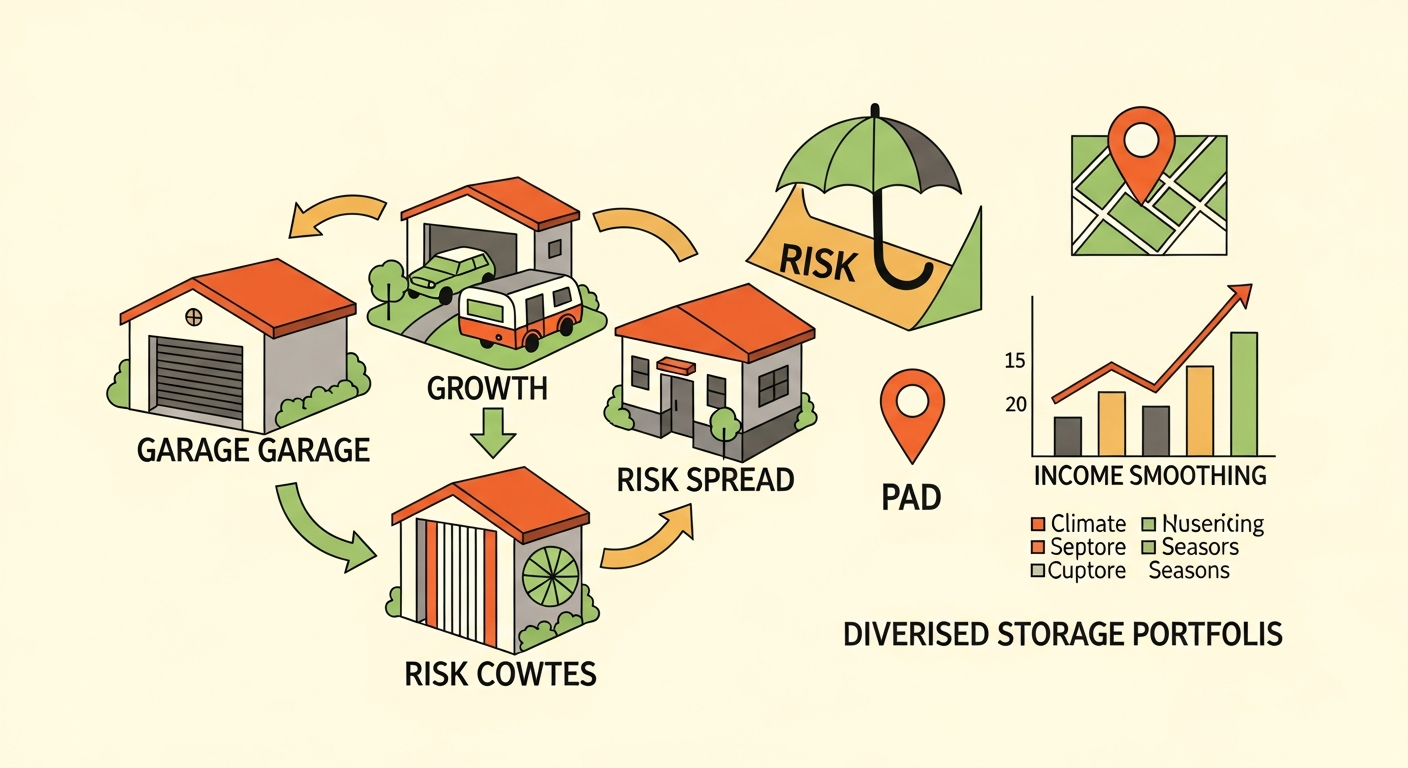
Diversification means three different things for a storage host, and they carry genuinely different risk profiles. Adding another space of the same type in the same market leverages what's working but concentrates your exposure. Adding a different space type spreads demand risk across renter needs. Adding a different location spreads market and regulatory risk but adds operational complexity you may not want. This article covers which path fits which situation, and how to validate demand before committing to any of them.
This assumes your first listing is working and you have real earnings data behind it. Local market conditions vary enormously, so validate every decision here against your own market rather than treating any of it as a formula.
Path One: More of the Same Space Type
The lowest-friction expansion, and often the right first move.
The case for it: you already know this space type performs in this market. You have real occupancy data, a working price point, a listing template that converts, and an operational routine. A second identical space plugs into all of it with almost no learning curve.
The risk it carries: concentration. Two garage bays in the same neighborhood are exposed to exactly the same things -- the same local demand pool, the same regulatory environment, the same competitive pressure if a facility opens nearby. Portfolio risk, meaning the chance that a single event hurts multiple assets simultaneously, is at its highest here.
The specific danger: cannibalization. A second identical space in the same area may compete with your first for the same renters rather than adding incremental demand. This is the thing hosts most consistently underestimate, and it's covered in detail below.
When it makes sense: when your first space fills quickly, you've turned renters away, and comparable listings nearby are also occupied. That combination is evidence of unmet demand rather than a demand pool you've already captured.
Path Two: A Different Space Type, Same Location
Adding an RV pad alongside a garage bay, or climate-controlled space alongside standard storage.
The case for it: different space types serve different renter needs -- vehicle storage, household goods, climate-sensitive items -- so demand for each is only loosely correlated. When household storage demand softens, RV storage demand may not, because the people renting them want different things for different reasons. That's real diversification within one market.
The risk it carries: you're operating without the data advantage that made path one easy. A new space type means new demand assumptions, new pricing, new renter expectations, and possibly new equipment cost -- climate control being the obvious example, where Neighbor host climate control ROI covers whether the investment clears at all in your market.
What stays easy: you're still local. Access, maintenance, and renter coordination remain hands-on, which is most of what makes multi-space hosting manageable.
When it makes sense: when your local market shows validated demand for a different type -- comparable listings of that type exist, are priced above the floor, and are actually occupied -- and you have the physical space or can acquire it reasonably.
Path Three: A Different Location
A space in another city or region.
The case for it: this is the only path that spreads regulatory and market risk. A local ordinance change, a new competing facility, or a demand shift in one market doesn't touch the other. If you're worried about single-market exposure, this is the answer.
The risk it carries: operational complexity, and more than hosts expect. You can't easily show a renter the space, handle an access issue in person, or deal with a problem on short notice. You need reliable remote access systems, possibly local help, and a tolerance for being unable to just drive over.
The hidden cost: you also lose your local market knowledge. In your home market you know what people store, what the demand rhythm is, and which comparables are real. In a new city you're starting from research rather than experience, which is exactly the position that makes overpaying and mispricing likely.
When it makes sense: when you have a genuine reason to be in that market -- property you already own, family there, a market you know well -- or when your home market is saturated enough that further local expansion doesn't pencil.
The Decision Framework
| Path | Risk Profile | Operational Complexity | When It Makes Most Sense |
|---|---|---|---|
| More of the same type, same area | Highest concentration; cannibalization risk | Lowest -- you already know the playbook | Demand clearly exceeds your capacity; comparables also full |
| Different type, same location | Moderate; demand risk spread across renter needs | Low-moderate -- local, but new assumptions | Validated local demand for the new type exists |
| Different location | Lowest concentration; spreads regulatory and market risk | Highest -- remote management, no local knowledge | Home market saturated, or you have a real reason to be in that market |
The general sequencing most successful hosts follow: exhaust genuine unmet demand in your home market first (paths one and two), then consider geography. Path three solves a risk problem, and it's only worth its complexity once you actually have concentration worth diversifying away from.
Evaluating Market Saturation Before Adding Nearby
Market saturation -- the point where local supply meets or exceeds local demand -- is what determines whether a second same-type space adds income or splits it.
How to actually check, before committing:
Count comparable listings in your area. How many similar spaces exist within the radius a renter would realistically consider? A handful in a populated area suggests room. Many, in a small area, suggests saturation.
Check their occupancy, not just their existence. This is the step that matters. Comparable listings sitting vacant means supply already exceeds demand, and your second space joins the queue. Comparables consistently booked means demand is genuinely unmet.
Check their pricing trend. If comparable rates have drifted down, supply is outpacing demand.
Look at your own history. Did your first space fill quickly? Have you turned inquiries away? Did it refill fast after a vacancy? Fast fills and turned-away renters are the strongest evidence of unmet demand you'll get, because it's demand you personally observed rather than inferred.
If comparables are full and your space fills fast, add nearby. If comparables are empty or your space took months to fill, adding another one competes with yourself -- and the right move is a different type or a different location instead.
How Space Types Interact With Portfolio Risk
Not all storage demand behaves the same way, and understanding the differences is what makes diversification by type actually reduce risk rather than just add complexity.
Seasonal demand patterns. Vehicle and RV storage often shows a seasonal demand pattern -- demand rising when vehicles go into storage for a season and falling when they come back out. Household goods storage tends to be steadier, since people store for moves, transitions, and downsizing year-round rather than on a calendar.
Tenancy length. Climate-controlled and household storage often produce longer tenancies, since people storing archives, furniture, or collections are settled in. Vehicle storage can be more cyclical, with renters coming and going with the season.
Price sensitivity. Basic storage renters tend to be more cost-driven, since a facility is an easy substitute. Specialty needs (climate control, RV) tend to be less substitutable and less price-sensitive where the need is genuine.
The practical implication: pairing a seasonal space type with a steadier one smooths your portfolio income across the year in a way that two of the same type never will. A garage bay plus an RV pad produces a more stable annual income than two garage bays, even if the headline numbers look similar -- and the smoothing is the actual benefit of diversifying by type, not just having more listings. RV storage hosting income covers the vehicle-storage side specifically.
Worked Scenario One: Diversifying by Space Type
A host with a well-performing garage bay, considering what to add.
The situation: the garage bay fills consistently and refills within days of vacancy. They have driveway space available on the same property.
Option A, second garage bay: they'd need to build or convert. Comparable garage listings nearby are mostly occupied, which is a positive signal -- but they'd be adding capacity to the same demand pool they're already serving.
Option B, RV/vehicle pad on the existing driveway: low conversion cost (it's already a driveway). Different renter pool entirely. Demand check: comparable RV and vehicle storage listings in the area exist, are priced meaningfully, and are occupied. That's validated demand.
The read: Option B, and it isn't close. Near-zero build cost, a genuinely different renter pool, and a seasonal pattern that complements the steadier garage demand. The portfolio income smooths out and the two listings don't compete with each other.
The caveat they check first: whether local rules or an HOA restrict vehicle storage on a driveway. That's a five-minute check that prevents an expensive assumption.
Worked Scenario Two: Adding a Location
The same host, two years later, with three well-performing spaces at one property, considering a space in another city.
The motivation: genuine concentration concern. Everything they own sits at one address in one jurisdiction. A local ordinance change or a new self-storage facility opening nearby would hit all three simultaneously.
What they gain: real regulatory and market risk reduction -- the only path that provides it.
What they take on:
- No ability to handle access issues in person. Remote access systems become mandatory, not optional. - No local market knowledge. They're pricing from research, not experience. - Possibly local help for anything physical, which is a cost and a reliability dependency. - Doubled attention across two markets' comparables, pricing, and regulations.
The read: worth it only if the concentration risk is genuinely bothering them and they have some real connection to the second market -- property they own, family nearby, a city they know. Expanding into a randomly-chosen market purely for diversification usually means paying the operational cost without the local knowledge to earn it back.
The de-risking move: start small. One low-cost space in the new market, run for six to twelve months, before committing further. You're testing your ability to operate remotely as much as testing the market -- and that's the variable most hosts overestimate about themselves.
Common Mistakes
Over-concentrating because the first listing succeeded. Success in one space type in one market is evidence about that space type in that market, not a general mandate to replicate. Three identical spaces in one neighborhood is a concentrated bet, however well the first one performed.
Expanding into a space type with no validated local demand. Adding climate control or RV storage because it earns more elsewhere, without checking whether local comparables of that type are priced up and occupied. Validate first, always.
Underestimating remote operational overhead. Managing spaces in two locations is more than twice the work of one, not because of the spaces but because of the context-switching, the loss of in-person problem-solving, and the dependency on local help. Hosts consistently underestimate this.
Cannibalizing your own demand. Adding a same-type space nearby when your local demand pool is already served, then watching both spaces sit at partial occupancy where one sat full. Two half-full spaces earn less than one full one after the added cost.
Diversifying before the first listing has real data. Covered below -- this is the most common timing error.
Ignoring how expansion interacts with pricing. More capacity in a market may require repricing to fill, which changes the economics of the space you already had. Neighbor host occupancy rate optimization covers holding occupancy as you add supply.
When Diversification Isn't the Right Move Yet
If your first listing has been running for a few months, you don't yet have enough data to expand on.
A short run doesn't reveal a reliable occupancy pattern. You haven't seen a full seasonal cycle, you haven't seen how quickly the space refills after a vacancy, and you may not have seen a vacancy at all. Expanding on that basis means replicating assumptions you haven't validated -- and if the assumption is wrong, you've now got two spaces built on it instead of one.
Give the first listing roughly a year, or at least a full seasonal cycle if your space type is seasonal. What you're looking for: a stable occupancy pattern, a price point that holds, and clear evidence of whether demand exceeded what you could serve.
The exception: a near-zero-cost addition, like listing an already-existing driveway alongside a garage. When the downside is a listing that doesn't rent and the cost is an afternoon, the usual caution about waiting for data matters much less.
Frequently Asked Questions
Should I add a second space of the same type or try a different one?
Same type if your first space fills fast, you've turned renters away, and comparable listings nearby are also occupied -- that's unmet demand. A different type if your local demand for the first type looks served, since a second identical space would compete with your own. The occupancy of nearby comparables is your best signal.
How do I validate demand for a new space type before investing?
Check comparable listings of that type in your area for three things: whether they exist, whether they're priced meaningfully above the floor, and whether they're actually occupied. Priced-well-and-booked is validated demand; existing-but-empty is a warning. An afternoon of research prevents the expensive version of this mistake.
How should I diversify if my first space type is highly seasonal?
Deliberately pair it with a steadier type. If vehicle or RV storage drives your income and it swings seasonally, adding household or climate-controlled storage smooths annual income far better than adding another seasonal space would. The whole point of diversifying by type is decorrelating the demand -- adding more of the same seasonal exposure just amplifies the swing.
Is it worth diversifying into equipment or tool rental rather than staying in storage?
It's worth considering, with a clear caveat: it's a genuinely different business, not an adjacent storage product. Tool and equipment rental involves per-use turnover, condition management, and damage exposure that passive storage doesn't -- closer operationally to vehicle hosting than to storage. It can decorrelate income well precisely because it's different, but don't assume your storage operational experience transfers. Treat it as entering a new category, and look at sharing economy portfolio diversification for how cross-category expansion is usually evaluated.
How many spaces before I need to worry about saturating my own market?
There's no fixed number -- it depends entirely on local demand depth. The signal isn't count, it's behavior: if a new space takes noticeably longer to fill than your previous one did, or if you have to price below your established rate to fill it, you're approaching saturation. Watch fill time, not listing count.
Does managing spaces in two cities really double the work?
More than double, in practice. The spaces themselves aren't the issue -- it's losing the ability to solve problems in person, maintaining awareness of two markets, and depending on local help for anything physical. Budget for meaningfully more overhead than the space count suggests, and test with one low-cost space before committing.
Should I diversify or just optimize what I have?
Optimize first if your existing spaces aren't at strong occupancy at a defensible rate. Diversification adds complexity; optimization adds income without it. If a current space is underperforming, fixing that returns more than a new space would -- see the Neighbor multi-space host strategy for sequencing this properly.
The Takeaway
A sound self storage host diversification strategy starts by naming which kind of diversification you actually want: more capacity where demand is proven, a different space type to decorrelate demand within your market, or a different location to spread regulatory and market risk. Validate demand for any new type or market by checking whether comparable listings are both priced up and occupied, give your first listing a full seasonal cycle before expanding on its data, and remember that adding a same-type space nearby competes with yourself unless the local demand genuinely exceeds what you're already serving.