Once you're running more than one or two vehicles, Turo insurance stops being a single checkbox decision and becomes a real cost-and-exposure calculation. Per-vehicle protection costs stack, your personal auto policy almost certainly won't extend to Turo rentals, and commercial exposure grows with every car you add. This article breaks down how Turo fleet insurance for hosts actually works at scale — the gaps, the tradeoffs, and when a dedicated policy starts making more sense than relying on platform protection alone.
This assumes you already know Turo's protection plan tiers exist. What follows is how coverage decisions change once you're operating a fleet, not a single car. One caveat throughout: specific coverage terms, limits, and exclusions vary by protection tier, insurer, and state or province, and should be verified directly with Turo's current terms and a licensed insurance professional — treat nothing here as universal.
How Turo's Protection Plan Tiers Work at Fleet Scale
Turo's built-in protection plans let a host trade a share of earnings for a level of coverage, with higher tiers taking a larger cut in exchange for lower host financial responsibility. At the fleet level, two things about these tiers matter more than they do for a single car.
The tier choice repeats across every vehicle. Whatever tier logic you apply gets multiplied by your fleet size. A tier that costs a tolerable share of earnings on one car compounds across ten, which is why fleet operators tend to scrutinize the tier-vs-deductible tradeoff far more carefully than single-car hosts do.
A deductible is what you pay out of pocket toward a covered claim before coverage applies. Lower tiers typically carry higher deductibles — meaning more out-of-pocket exposure per incident. Across a fleet, incident frequency rises simply because you have more cars on the road more often, so a high-deductible tier that rarely bites for a single-car host can bite repeatedly at fleet scale.
What platform protection typically doesn't cover is as important as what it does. Coverage often has limits that a high-value vehicle can exceed, and specific scenarios — certain uses, certain drivers, damage during non-rental periods — may fall outside it. Verify the exact exclusions against Turo's current terms rather than assuming, since this is where fleet hosts most often discover a gap.
Why Your Personal Auto Policy Usually Doesn't Help
This is the gap that catches the most hosts off guard: a personal auto insurance policy almost always excludes commercial use, and renting a vehicle out on Turo is commercial use. That means when a car is being used as a Turo rental, your personal policy typically won't respond to a claim.
The dangerous grey area is the non-rental legs. Consider a delivery scenario — you're driving the car to a renter, or repositioning it between rentals. Whether that leg counts as personal or commercial use for insurance purposes is exactly the kind of ambiguity that produces a denied claim at the worst moment. Gap coverage — insurance filling the space between what one policy covers and what another doesn't — exists precisely for these seams, and it's a bigger concern for a fleet operator with more vehicles to move between rentals.
The practical point: assuming your personal policy provides a safety net under platform protection is one of the most expensive mistakes a scaling host can make, because you often don't discover the exclusion until a claim is denied.
When a Commercial or Fleet Policy Becomes Worth It
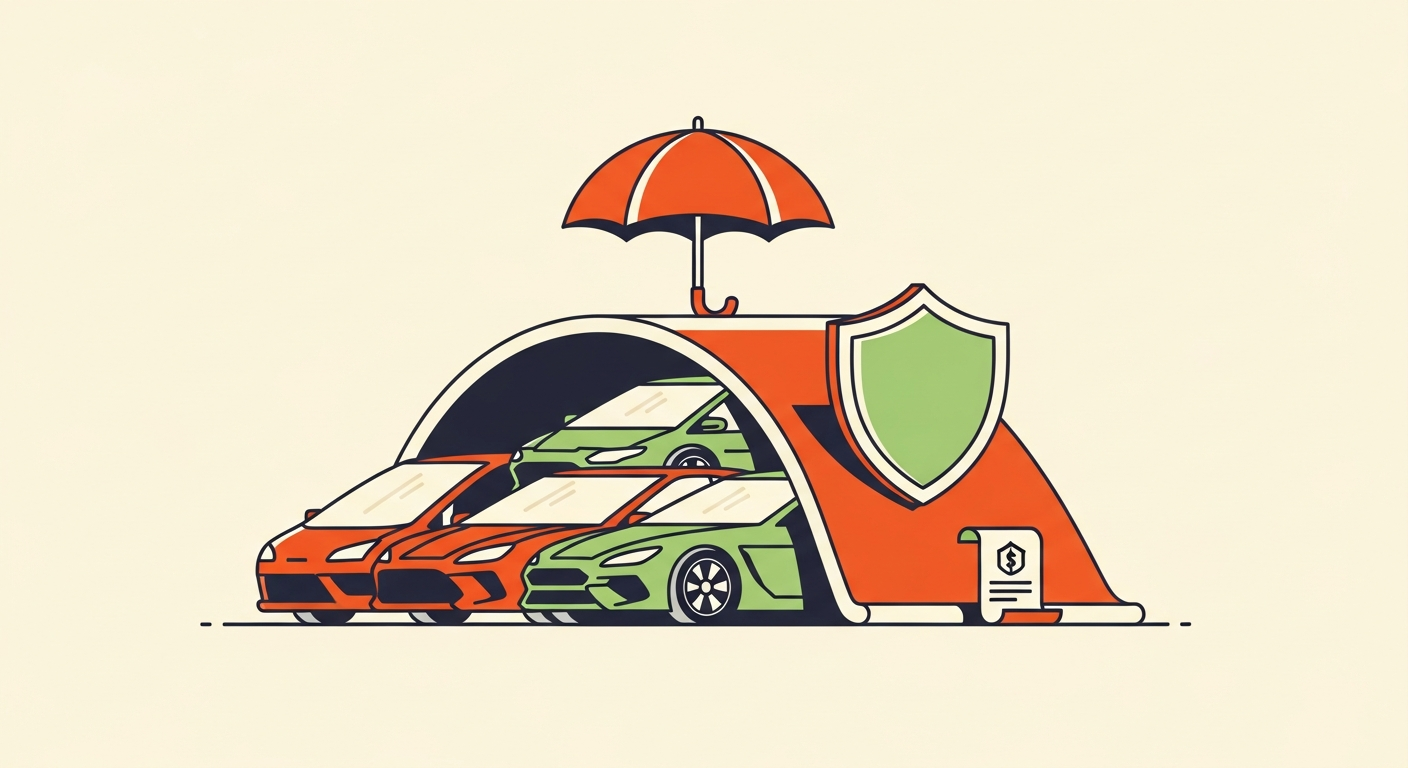
A commercial auto policy — coverage designed for business use of vehicles, rather than personal use — costs more upfront but closes the commercial-use gap that platform protection and personal policies leave open. The question is when the added cost is justified.
The math tends to favor a dedicated commercial or fleet policy as:
- Fleet size grows. More vehicles means more incident exposure and more of those ambiguous non-rental legs. At a certain vehicle count, insuring comprehensively as a business becomes cheaper and cleaner than managing tier-by-tier platform exposure across every car.
- Vehicle value rises. If your cars are valuable enough that a serious claim could exceed a protection tier's limit, that limit gap is a direct financial exposure a commercial policy can close.
- You formalize the business. Many fleet operators move to a Turo host LLC structure as they scale, and a commercial policy generally fits that structure better than a patchwork of personal-plus-platform coverage.
There's no universal threshold, since it depends on vehicle value, local rates, and your risk tolerance — but the inflection point for most operators arrives somewhere in the transition from a few cars to a proper fleet. A sharing economy insurance broker who understands peer-to-peer rental specifically is worth consulting here, since generic commercial auto brokers don't always grasp how platform protection interacts with a standalone policy.
Coverage Approaches Compared
| Approach | What It Typically Covers | Typical Cost Structure | Who It Tends to Fit |
|---|---|---|---|
| Platform protection plan tiers | Coverage during active rentals, subject to tier limits and deductibles | Share of trip earnings, varies by tier | Single-car and very small fleet hosts, or as a base layer |
| Personal auto policy add-on (where available) | Limited; personal use only, rarely commercial rental use | Added premium on existing policy | Rarely sufficient alone for Turo use; verify exclusions carefully |
| Dedicated commercial / fleet policy | Business use including ambiguous non-rental legs; higher limits available | Standalone premium, often scaling with fleet size and value | Multi-vehicle operators, high-value fleets, formalized businesses |
Treat every entry as a general pattern, not a quote — actual coverage, limits, and cost depend on your insurer, state or province, and the specific policy, and must be confirmed with a licensed professional.
How Insurance Costs Scale as a Fleet Grows
Insurance cost doesn't always scale linearly with fleet size, and understanding that shapes when to switch approaches.
Relying on platform protection tiers scales roughly linearly — each car carries its own earnings-share cost, so ten cars cost roughly ten times one. A commercial fleet policy often scales sub-linearly, since insurers may price a fleet more efficiently than ten individually-protected vehicles. That crossover is part of why the commercial option gets more attractive as fleet size grows: the per-vehicle cost can actually improve at scale in a way platform tiers don't.
Utilization matters here too. A car with high Turo vehicle utilization rate — booked a large share of available days — carries more on-road exposure than one that sits idle, which affects the real risk you're insuring. Factoring utilization into coverage decisions, rather than treating every vehicle identically, is a mark of a more sophisticated multi-car Turo host strategy. Tracking this well usually means having decent operational data in the first place, which is where Turo fleet management software enters the picture.
Common Coverage Mistakes Fleet Hosts Make
Assuming personal insurance covers the gaps. As covered above, personal policies typically exclude commercial rental use. Relying on one as a backstop is a denied claim waiting to happen.
Choosing the cheapest tier without understanding the deductible. The lowest-cost protection tier looks efficient until a claim arrives and the high deductible lands — repeatedly, across a fleet with more incident exposure than a single car. Model the deductible against realistic incident frequency, not best-case.
Not re-evaluating coverage as the fleet grows. A coverage approach that fit three cars may be both more expensive and less protective than a commercial policy once you're at eight. Coverage should be revisited on a schedule as the fleet scales, not set once and forgotten.
Overlooking non-rental legs. Delivery and repositioning are where personal and platform coverage most often both fail to respond. If your operation involves regular delivery, this exposure deserves specific attention.
Ignoring payment-dispute exposure. Insurance covers damage, but a separate category of loss comes from payment reversals. Turo host chargeback protection covers that gap, which insurance policies generally don't touch.
Coverage decisions also interact with how well you maintain the fleet — a documented Turo fleet maintenance schedule both reduces incident likelihood and helps substantiate that a vehicle was properly maintained if a claim is ever questioned.
Frequently Asked Questions
Does Turo's protection plan mean I don't need my own insurance?
Not necessarily. Platform protection covers active rentals subject to tier limits and deductibles, but it may leave gaps — high-value claims exceeding limits, ambiguous non-rental legs, certain exclusions. Many fleet hosts carry additional coverage for exactly these gaps. Verify your specific situation with a licensed professional.
Will my personal car insurance cover my Turo rentals?
Almost always no. Personal auto policies typically exclude commercial use, and Turo rental is commercial use. Relying on a personal policy usually means an uncovered claim. This is one of the most common and costly misunderstandings among scaling hosts.
At how many cars should I get a commercial fleet policy?
There's no fixed number, since it depends on vehicle value, local rates, and risk tolerance. The math generally shifts toward a commercial policy as fleet size and vehicle value grow and as you formalize the business. Many operators cross that line in the transition from a few cars to a real fleet.
What's a deductible and why does it matter more at fleet scale?
A deductible is what you pay out of pocket toward a covered claim before coverage kicks in. It matters more across a fleet because more vehicles mean more incidents, so a high-deductible tier that rarely bites for one car can hit repeatedly across many.
Does an LLC change my insurance needs?
Formalizing as an LLC often pairs naturally with a commercial policy, since both reflect operating as a business rather than an individual. The LLC itself doesn't provide insurance coverage, though — it's a liability structure, not a substitute for a policy. Consult both a licensed insurance professional and an attorney.
The Takeaway
Turo fleet insurance for hosts is fundamentally different from single-car coverage: deductibles compound across vehicles, personal policies leave commercial-use gaps, and a dedicated commercial policy often becomes both cheaper and more protective as the fleet grows. Re-evaluate your coverage as you scale rather than assuming what worked for one or two cars still fits, and verify every specific term with Turo's current documentation and a licensed insurance professional.