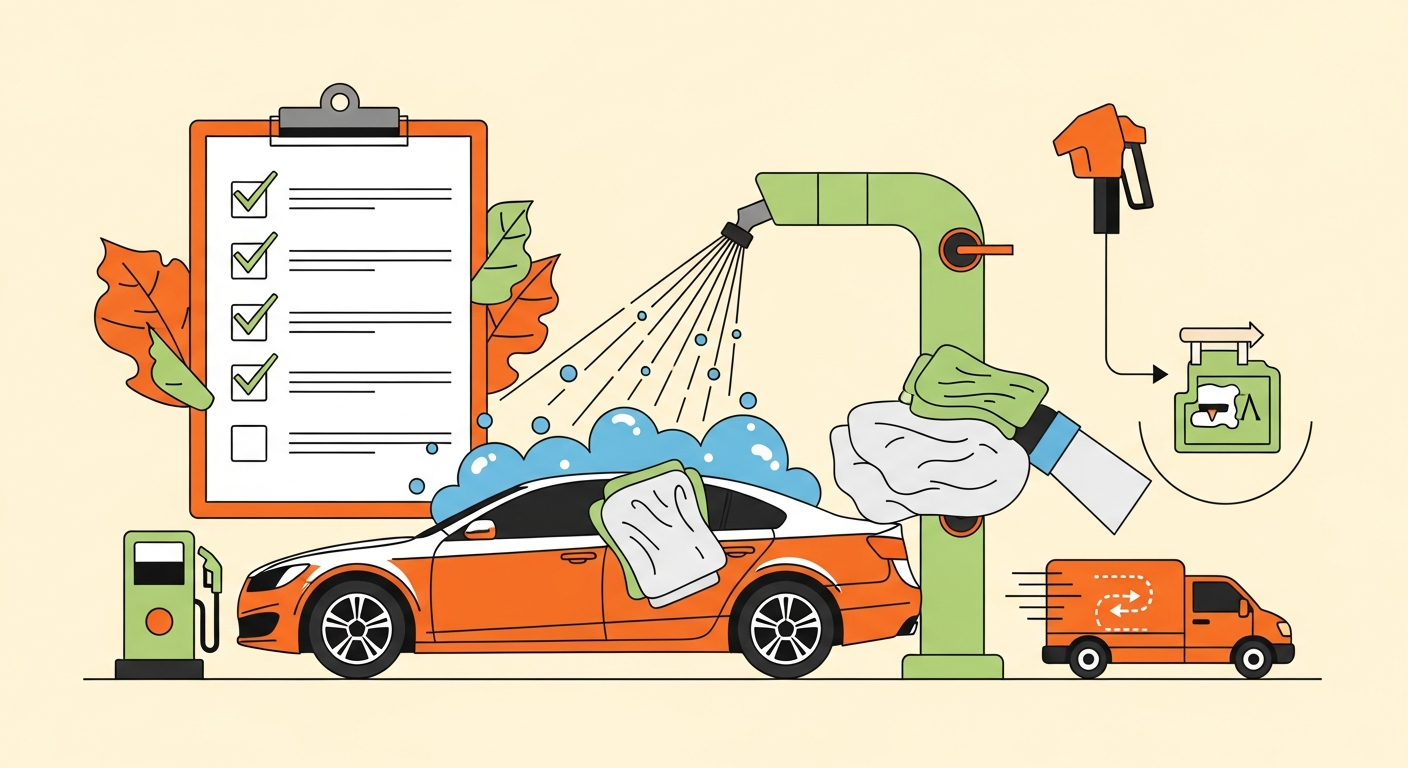
Turnover time is the biggest hidden drag on utilization in most Turo fleets, and it hides well -- a car sitting idle for cleaning or logistics is lost revenue that never appears as a line item anywhere. Nobody bills you for it. You just quietly earn less. This article covers what actually consumes turnover time, how to compress it without cutting the documentation corners that matter, and how to set scheduling buffers from real numbers rather than optimism.
Time estimates throughout are starting points to calibrate against your own fleet -- they vary by vehicle type, cleaning method, and location logistics. Use them to build a buffer, then adjust once you're tracking your actual numbers.
What Actually Consumes Turnover Time
Turnover time is the gap between one renter dropping off and the next picking up. Four things fill it:
Cleaning. Usually the largest single block, and the most variable. A tidy return needs a wipe-down and vacuum. A genuinely dirty return can take three times as long.
Inspection and damage documentation. Photo walkarounds at return and before the next handoff. The step most often rushed and the one that costs most when rushed.
Refueling. Sounds trivial. Isn't -- it's a drive, a queue, and a return drive, and it's frequently the step operators forget to budget for at all.
Repositioning. Moving the vehicle back to its pickup location, or out for delivery. For fixed-location fleets this is near zero; for delivery-based operations it dominates everything else.
The pattern worth internalizing: for fixed-location vehicles, cleaning is the bottleneck. For delivery-based vehicles, driving is. Those need different solutions, which is why a single turnover process copied across both fails.
Building a Fast Process Without Cutting Documentation
Here's the tradeoff that matters most, stated plainly: you can compress cleaning aggressively. You cannot compress documentation.
Skipping the photo walkaround saves maybe five minutes. When a renter causes damage and you have no timestamped pre-trip baseline, that five minutes costs you the entire claim -- the Turo host chargeback protection process is built almost entirely on matched before-and-after evidence. There is no version of this trade that works out.
So compress everything else:
Standardize the cleaning sequence. Same order, every time, every car. Sequence beats speed -- a repeatable order eliminates the backtracking that actually eats time, and it means you never have to think about what's next.
Stage supplies in the vehicle or at the location. Time spent locating a vacuum is pure loss. A Turo cleaning turnaround checklist covers the specific sequence; the meta-point is that everything you need should be where the car is.
Make documentation a fixed ritual, not a judgment call. Same walkaround path, same shots, same order, every single time. Made routine, a full photo walkaround runs 5-7 minutes. Treated as optional, it gets skipped exactly when you're rushed -- which is exactly when the damage happened.
Batch what can be batched. Refueling three cars in one trip beats three separate runs.
The mental model: documentation is fixed cost, cleaning is variable cost. Optimize the variable one.
Real Time Estimates and Scheduling Buffers
Rough per-step estimates for a standard vehicle, normal return condition:
| Step | Typical Time | Notes |
|---|---|---|
| Photo documentation (return) | 5-7 min | Non-negotiable; fixed cost |
| Interior clean (vacuum, wipe-down) | 20-30 min | Doubles or triples on a dirty return |
| Exterior wash | 20-40 min | Skippable on short turnarounds if clean |
| Refuel | 15-25 min | Drive, queue, return -- budget it properly |
| Restaging (return to pickup spot) | 5-45 min | Restaging means returning the vehicle to its ready position; near-zero at a fixed lot |
| Photo documentation (pre-handoff) | 5-7 min | Non-negotiable |
Realistic total for a fixed-location vehicle: 60-90 minutes on a normal return. 2-3 hours on a bad one.
Now the actual lesson: build your buffer for the bad return, not the good one. Operators budget 60 minutes because that's what a clean return takes, then a dirty return blows the schedule and the next renter waits. Waiting renters leave bad reviews, and a bad review costs more than the extra hour of buffer ever would.
Budget 2 hours minimum at a fixed location. More if delivery is involved.
Worked Example One: Fixed-Location Vehicle
An economy sedan, returned to your lot, next booking that afternoon.
- 11:00 -- Renter returns. Photo documentation: 6 minutes.
- 11:06 -- Interior clean. Return is normal: 25 minutes.
- 11:31 -- Exterior looks fine, skip the wash.
- 11:31 -- Refuel run: 20 minutes.
- 11:51 -- Back at the lot. Restaging: 3 minutes.
- 11:54 -- Pre-handoff documentation: 6 minutes.
- 12:00 -- Ready. Total: 60 minutes.
The bottleneck: cleaning. It's over 40% of the cycle and the only step with real variance. If that return had been dirty, the whole thing runs 90-120 minutes.
The optimization: mobile detailing. A detailer who comes to your lot converts your 25-40 minutes into someone else's, and does it while you handle documentation on another car. At single-vehicle volume the cost is hard to justify; across a fleet with several turnovers a week, it's frequently the highest-ROI spend in the entire operation.
Worked Example Two: Delivery-Based Vehicle
The same sedan, but delivery-based -- returned at an airport, next renter at a hotel across town.
- 11:00 -- Collect vehicle at airport. Documentation: 6 minutes.
- 11:06 -- Drive to your cleaning location: 25 minutes.
- 11:31 -- Interior clean: 25 minutes.
- 11:56 -- Refuel: 20 minutes.
- 12:16 -- Drive to delivery point: 30 minutes.
- 12:46 -- Pre-handoff documentation: 6 minutes.
- 12:52 -- Ready. Total: nearly 2 hours.
The bottleneck: driving. 55 minutes of the cycle -- almost half -- is repositioning. Cleaning improvements barely move this number.
The optimization is entirely different. Route efficiency, not cleaning speed. Cluster deliveries geographically, build a Turo remote delivery loop that chains multiple vehicles into one circuit, tighten the delivery radius -- the geographic range you'll deliver within -- so repositioning drives stay short. A wide delivery radius wins bookings and destroys turnover economics; that's a real tradeoff to price deliberately, not accept by default.
Same car, same cleaning process, completely different problem. That's why a single turnover playbook across a mixed fleet doesn't work.
The Turnover Checklist
Adapt the times to your fleet:
- Photo documentation on return (5-7 min) -- full walkaround, timestamped, odometer, fuel gauge.
- Assess condition (2 min) -- decide the cleaning scope now, so you're not re-deciding mid-task.
- Remove trash and personal items (3-5 min).
- Interior vacuum (10-15 min).
- Interior wipe-down (10-15 min) -- touchpoints first: wheel, shifter, handles, controls.
- Exterior wash if needed (20-40 min) -- skip when genuinely clean and the clock is tight.
- Refuel (15-25 min) -- batch across vehicles when you can.
- Restage (5-45 min) -- return to pickup position or stage for delivery.
- Pre-handoff photo documentation (5-7 min) -- same sequence as step 1, matched.
- Confirm access (2 min) -- lockbox code rotated, keyless credentials issued. See Turo host key exchange systems.
Steps 1 and 9 are fixed. Everything else is negotiable under time pressure.
When to Hire Turnover Staff
The honest math: at some point your time is worth more than the turnover is costing, and the transition sneaks up on operators who've always done it themselves.
One to three vehicles: do it yourself. Volume doesn't justify the coordination overhead of managing someone.
Four to six vehicles: this is where most operators should move at least cleaning to a mobile detailer. You're doing several turnovers weekly, and cleaning is the largest compressible block. Detailing is the natural first outsource because it's high-time, low-judgment, and easy to specify.
Seven-plus vehicles: dedicated turnover help becomes worth it, and the real constraint stops being cost and becomes reliability. A turnover person who doesn't show up is worse than no turnover person, because you've scheduled around them.
The trap: keeping documentation in-house while outsourcing cleaning, and then never actually inspecting the car yourself. If your detailer isn't documenting, you've created a gap in exactly the evidence chain that protects you. Either they document to your standard, or you're still there for that step.
Common Mistakes
Underestimating turnover time. The most common one. Budgeting for the good return produces scheduling conflicts on every bad one. Budget for the bad return.
Cutting inspection corners to save time. Covered above and worth repeating, because it's the mistake with the worst payoff ratio in the entire operation. Five minutes saved, an entire claim lost.
Not tracking turnover time at all. Without data you can't see the pattern -- which vehicle consistently takes longer, which location adds 30 minutes of repositioning, which renter profile returns cars dirty. The bottleneck is knowable, and most operators never look. Track it per vehicle for a month; the pattern is usually obvious and usually not what you'd have guessed. Decent Turo fleet management software logs this alongside everything else.
Optimizing the wrong step. Chasing cleaning speed on a delivery-based vehicle where driving is 50% of the cycle. Measure first, then optimize what's actually large.
Ignoring maintenance in the turnover window. Turnover is when the car is in your hands. A Turo fleet maintenance schedule that syncs service to turnover windows avoids separate downtime later -- otherwise you're taking the car offline twice.
When Turnover Optimization Matters Less
Be honest about this: if you run one vehicle with naturally spaced bookings -- a trip a week, days of gap between -- formalizing a turnover process is solving a problem you don't have.
Turnover optimization pays off proportionally to turnover frequency. At low utilization, the dead time isn't costing you bookings, because there's no next booking waiting. You can take three hours; nobody's affected. The ROI on a formalized system, tracking, and staffing decisions is genuinely low here.
The threshold is roughly where turnover time starts colliding with the next booking, or where you're declining back-to-back bookings because you can't turn the car fast enough. That's when this becomes real, and it typically shows up alongside a multi-car Turo host strategy rather than a single vehicle.
Do keep the documentation discipline regardless. That's not turnover optimization -- that's basic protection, and it matters at one car exactly as much as at ten.
Frequently Asked Questions
How long should a Turo turnover realistically take?
Budget 60-90 minutes for a fixed-location vehicle on a normal return, and up to 2-3 hours on a dirty one. Delivery-based turnovers commonly run 2+ hours because repositioning dominates. Build buffers for the bad case, not the average.
Should turnover expectations change for a luxury or specialty vehicle?
Yes, significantly. Luxury and specialty vehicles carry higher renter expectations, so cleaning standards are higher and the acceptable margin for a missed detail is much narrower -- add 30-50% to your cleaning estimate. Documentation matters more too, since damage claims on high-value vehicles are larger and more likely to be contested. Rushing a luxury turnover is a false economy twice over.
What do I do when back-to-back bookings leave no buffer at all?
Two honest options: decline the second booking, or set a realistic minimum gap in your availability settings so the platform never offers a back-to-back you can't service. The third option -- accepting it and rushing -- means either a late handoff or skipped documentation, and both cost more than the booking is worth. Fix this in your settings rather than heroically each time.
Is mobile detailing worth it?
It becomes worth it around four to six vehicles, when you're running several turnovers a week and cleaning is your largest compressible block. Below that, coordination overhead usually exceeds the benefit. The math turns on your own time's value and turnover frequency, not on the detailer's rate in isolation.
How do I know which step is actually my bottleneck?
Track each step for a month. Most operators are surprised -- they assume cleaning and find it's refueling drives or repositioning. You cannot optimize what you haven't measured, and the guess is wrong often enough to matter.
Does faster turnover actually improve utilization much?
It does at high booking frequency, where turnover time directly gates how many trips a vehicle can take. At low utilization, the gaps aren't the constraint -- demand is. Check your Turo vehicle utilization rate first: if you're at 40%, turnover isn't your problem.
Can I skip the exterior wash to save time?
On a short turnaround with a genuinely clean exterior, yes -- it's the most legitimately skippable step. Just don't let "skip when clean" quietly become "skip always," and never extend that logic to documentation.
The Takeaway
Turo vehicle turnover optimization comes down to knowing which step is actually your bottleneck -- cleaning for fixed-location vehicles, driving for delivery-based ones -- and compressing that one while treating documentation as fixed and non-negotiable. Track your real turnover times per vehicle for a month, build scheduling buffers around the bad returns rather than the good ones, and outsource cleaning once the volume justifies it.