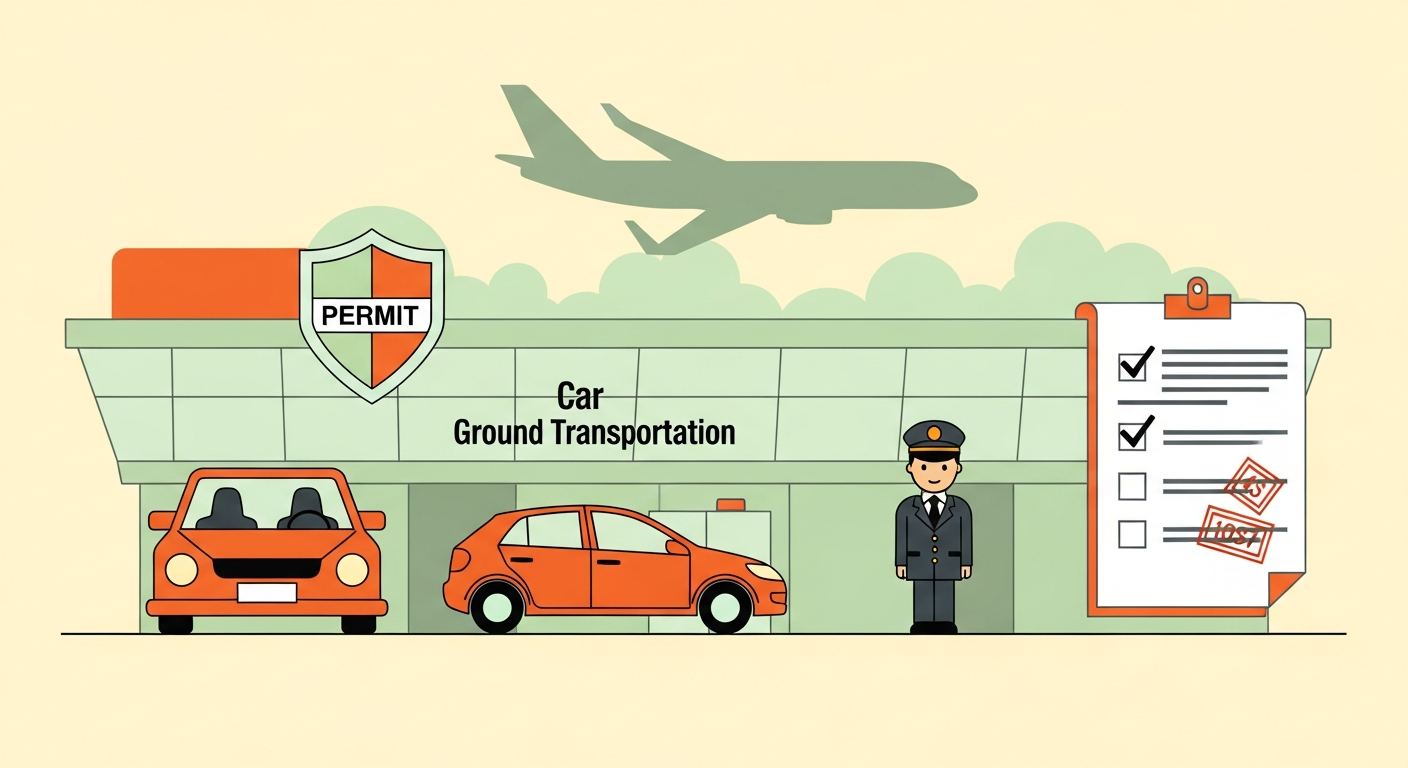
Most airports require some form of commercial ground transportation permit or operating agreement for regular vehicle rental activity on airport property, and operating without one carries real consequences -- citations, escalating fines, vehicle impoundment, and in persistent cases a ban from the airport entirely. This is not optional paperwork to skip because your volume is low. This article covers why airports regulate this, what the permit process generally looks like, what triggers enforcement, and how to find out exactly what your specific airport requires.
That last point matters more than anything else here. Airport requirements vary enormously -- by airport size, by local aviation authority, by existing agreements with rental companies -- and nothing in this article substitutes for verifying directly with your specific airport's ground transportation or aviation authority office. Treat what follows as a framework for asking the right questions, not as an answer.
Why Airports Regulate Peer-to-Peer Delivery
Three reasons, and understanding them tells you how seriously a given airport is likely to enforce.
Curbside congestion. Curbside congestion is exactly what it sounds like -- limited terminal frontage with rideshare, taxis, private pickups, and shuttles all competing for space. Airports manage this aggressively because it's an operational constraint on the whole facility. Any activity that adds unmanaged vehicle dwell time at the curb draws attention.
Revenue-sharing agreements with traditional rental companies. This is the underappreciated one. Rental car companies typically pay substantial concession fees for the right to operate on airport property, often a percentage of revenue plus facility charges. Unpermitted peer-to-peer delivery competes with that arrangement without contributing to it, which gives airports a direct financial motive to enforce -- and gives incumbent operators a motive to report activity they notice.
Security and access control. Airports track who is operating commercially on their property. A commercial activity happening outside that visibility is a control gap, independent of any revenue question.
The practical read: an airport where rental car concession revenue is significant, and where curbside is genuinely constrained, will enforce. A smaller airport with neither pressure often won't care much. That difference explains most of the variation you'll encounter.
What the Permit Process Generally Looks Like
Specifics vary too much to give you a universal walkthrough, but the general shape at airports that do require a ground transportation permit -- an authorization to conduct commercial vehicle activity on airport property -- tends to include some combination of:
An application to the ground transportation or landside operations office. Usually a form describing your business, vehicle count, and expected activity volume.
Business documentation. Business registration, sometimes an LLC or equivalent entity, and proof of commercial insurance meeting the airport's minimum limits. This one catches hosts off guard, because airport insurance minimums frequently exceed what a host carries -- and personal auto coverage almost never qualifies.
Vehicle registration or decals. Many airports require permitted vehicles to be individually registered and to display a decal or transponder, meaning your permit covers specific vehicles rather than your operation generally.
Fees. Commonly an annual or periodic permit fee, sometimes plus a per-trip charge collected via transponder or automated plate reading.
Designated operating areas. Your permit will specify where you may operate -- which lot, which curb zone, which level. Operating outside those areas is a violation even with a valid permit.
Two things worth confirming early: whether the airport treats peer-to-peer vehicle delivery as its own category or lumps it in with rental car operations (the latter can mean much higher requirements), and whether any platform-level agreement exists that covers individual hosts. Don't assume the latter -- confirm it with the airport, since a platform agreement in one market rarely means one everywhere.
What Triggers Enforcement
Hosts often assume enforcement is random. It usually isn't.
Repeat visible activity at the curb. Ground transportation officers work the curb continuously and recognize patterns. A vehicle appearing regularly for handoffs gets noticed, and a host doing several deliveries a week is visible in a way a one-time delivery isn't.
Reports from permitted operators. Rental companies and permitted shuttle operators pay for their access and have a direct interest in reporting activity that doesn't. This is a more common enforcement trigger than most hosts expect.
Dwell time at the curb. A handoff involving paperwork, a vehicle walkaround, and key exchange takes longer than a passenger drop-off, which is precisely the behavior curb enforcement is watching for.
Complaints or incidents. Any incident that draws attention -- a dispute, a blocked lane, a renter confusion situation -- puts your activity in front of someone official.
The consequence range, in rough escalation order: a verbal warning to leave, a citation with a fine, escalating fines for repeat violations, vehicle impoundment (with towing and storage costs plus the trip disruption), and formal trespass or ban from airport property. The last one is the genuinely damaging outcome, because it doesn't just cost money -- it permanently removes airport delivery from your business, and airport demand is often a meaningful share of a fleet's bookings.
There's also a knock-on risk worth naming: an incident occurring while you're operating without a required permit can complicate insurance and liability questions, since you were conducting unauthorized commercial activity at the time.
Worked Example One: A Major International Airport
A host with six vehicles wanting to offer regular delivery at a large international airport.
What they find: the airport's ground transportation office has a formal commercial permit program with a defined application, an annual fee, commercial insurance minimums above what the host currently carries, required vehicle decals, and a per-trip fee collected via transponder. Operations are restricted to a designated commercial lot -- not the terminal curb.
What it costs them: the annual permit fee, plus upgrading insurance to meet the minimums, plus per-trip charges, plus the operational cost of the designated lot being further from the terminal than the curb (which means longer handoffs and a renter walk or shuttle).
The decision: at six vehicles with strong airport demand, the math typically works -- airport bookings command higher rates and the delivery fee offsets much of the cost. The insurance upgrade often turns out to be worthwhile independently, since a fleet at that size arguably needed commercial coverage anyway.
What breaks if they skip it: at an airport this size, enforcement is active and the activity is visible. Skipping the permit here is a matter of when, not if.
Worked Example Two: A Smaller Regional Airport
The same host, but the nearest airport is a regional facility with a handful of daily flights.
What they find: no formal peer-to-peer delivery permit category exists. The airport's ground transportation policy addresses taxis and shuttles but is silent on this activity. A call to airport operations gets a straightforward answer: no permit required for occasional activity, just don't block the curb, and use the short-term lot.
What it costs them: effectively nothing beyond short-term parking.
The decision: easy. Airport delivery here is a low-cost differentiator.
The caution: get the answer in writing, or at least note who you spoke with and when. Informal permissions change, and "someone told me it was fine two years ago" is a weak position if a new policy arrives or a new officer interprets things differently. Re-verify periodically rather than assuming a one-time answer holds indefinitely.
The contrast is the entire lesson: same host, same activity, two completely different regulatory pictures. Never port an assumption from one airport to another.
Designated Meeting Zones and Off-Airport Alternatives
Where a permit is unavailable, prohibitively expensive, or slow to obtain, two workarounds are common.
Designated meeting zones. Many airports have established a designated meeting zone -- a specific area, often in a parking structure or a dedicated lot, where private and app-based pickups are permitted. Some airports allow vehicle handoffs here under lighter requirements than a full commercial permit, or under a general parking arrangement rather than a ground transportation permit. Confirm directly whether your intended activity is permitted in that zone, since "rideshare pickup is allowed here" does not automatically mean "vehicle rental handoff is allowed here."
Off-airport delivery. Handing off at a nearby hotel, parking facility, or business a short distance from the airport, with the renter covering the last leg by shuttle or rideshare. This sidesteps airport jurisdiction entirely. The cost is renter convenience, which is exactly what airport delivery was selling -- but a five-minute shuttle to a nearby lot is a far better outcome than an impounded vehicle, and many renters accept it without complaint if it's communicated clearly upfront.
Off-airport handoff also puts more weight on your instructions and access process. A renter navigating to an unfamiliar off-airport location needs the same specificity a distributed fleet requires -- photos, exact location, clear steps -- and a reliable Turo host key exchange system matters more when you're not meeting them at a terminal door.
How Costs and Requirements Scale With Volume
Requirements generally scale in tiers rather than smoothly.
Occasional delivery. Some airports have no practical mechanism to permit a genuinely one-off delivery, and enforcement risk is lower simply because visibility is lower. This is not the same as being permitted -- it's being unnoticed, which is a different and less durable thing.
Regular delivery as a service offering. Once airport delivery is something you advertise and do weekly, you're conducting a commercial ground transportation business at that airport by any reasonable definition. This is where a permit clearly applies and where enforcement risk rises sharply.
Fleet-scale operations. Higher volume can mean higher fee tiers, per-vehicle decal costs across the fleet, and sometimes stricter insurance requirements. Confirm whether fees are flat or volume-scaled before building a delivery-heavy model around assumed costs.
The planning implication: model permit costs against realistic delivery volume before making airport delivery a core part of your remote car delivery service on Turo. If a permit costs a fixed annual amount, it amortizes well across many deliveries and poorly across a few -- which sometimes argues for committing fully to airport delivery or skipping it, rather than doing it occasionally.
The Evaluation Checklist
Run this for each airport you'd deliver to:
- Find the airport's ground transportation policy page. Most airports publish commercial vehicle and ground transportation rules online. Start there.
- Look for a peer-to-peer or car-sharing category specifically. Note whether it's addressed distinctly, lumped with rental cars, or absent entirely.
- Contact airport operations or the ground transportation office directly. The published policy often predates peer-to-peer activity. A direct call gets a current answer.
- Ask specifically about vehicle handoff activity, not "delivery" generally, which can be misread as a courier question.
- Confirm whether any platform-level agreement covers individual hosts at that airport. Verify with the airport rather than assuming.
- Get the permit requirements in detail: application process, fees (annual and per-trip), insurance minimums, vehicle registration or decal requirements.
- Confirm exactly where you may operate -- which lots, zones, or curbs, and which you may not.
- Ask about the designated meeting zone and whether handoffs are permitted there.
- Document the answer: who you spoke with, when, and what they said. Written confirmation is better.
- Set a re-verification reminder. Annually, or whenever you notice policy signage changing.
For the operational side once you're permitted -- routing, timing, renter coordination -- Turo airport delivery logistics covers execution, and tracking which vehicles are permitted for which airports is exactly the kind of per-vehicle detail worth recording in your Turo fleet management software rather than memory.
Common Mistakes
Assuming a permit isn't needed because deliveries are infrequent. Frequency affects your enforcement risk, not your legal obligation. Low volume means you're less likely to be caught, which is a different claim than being compliant.
Continuing to deliver under an expired permit. Permits lapse, and hosts keep operating on the assumption they're still covered. Operating under an expired permit is functionally the same as operating without one -- and worse in some ways, since you're on record as knowing the requirement existed. Track renewal dates deliberately.
Delivering to areas not covered by your specific permit. A permit typically authorizes specific zones. Handing off at the terminal curb when your permit covers a designated commercial lot is a violation despite holding a valid permit. Read the operating-area terms, not just the approval.
Assuming one airport's rules apply at another. As the worked examples show, two airports can differ completely. Every airport requires its own verification.
Relying on an informal verbal permission indefinitely. Policies and personnel change. Re-verify periodically, especially at airports where the answer was "we don't have a category for that."
Not factoring permit cost into delivery pricing. If a permit carries annual and per-trip costs, your airport delivery fee should reflect them. Hosts frequently price airport delivery from convenience rather than from cost.
When to Skip Airport Delivery Entirely
Sometimes the right answer is not to.
If an airport's commercial permit process is unusually expensive, requires insurance limits far above what your fleet needs otherwise, or involves an approval process measured in months, the delivery fee revenue may simply not offset the cost and hassle -- particularly for a smaller fleet where the fixed annual cost spreads across few deliveries.
Run the arithmetic honestly: annual permit cost plus insurance delta plus per-trip fees, against realistic incremental revenue from airport bookings. If it doesn't clear comfortably, off-airport handoff at a nearby location captures much of the airport demand at none of the regulatory cost. Plenty of successful fleet operators do exactly this by choice, not as a fallback.
And if the honest answer is that you'd be operating unpermitted, skip it. The expected cost of an impoundment or a ban -- and the possibility that an incident during unauthorized activity complicates an insurance claim -- outweighs the delivery fees by a wide margin.
Frequently Asked Questions
Do I need a permit if I only deliver to the airport occasionally?
Your obligation generally depends on the airport's rules, not your frequency. Low volume lowers your enforcement risk but doesn't create an exemption. Ask the airport directly whether occasional handoffs require a permit -- some have a threshold, many don't distinguish, and a few have no mechanism for occasional activity at all.
Does a renter returning to a different terminal than pickup require anything additional?
Usually not a separate permit, but it can matter if your permit specifies operating areas and the return terminal falls outside them. This is a real gap hosts overlook -- the permit covers zones, not the trip. Confirm which areas your permit authorizes and communicate the correct return location to renters explicitly rather than letting them choose.
How do requirements differ for a one-time delivery versus a standing service offering?
Substantially at many airports. A standing offering advertised to renters is unambiguously commercial ground transportation activity, which is what permit programs are designed to capture. A genuine one-off sits in murkier territory at some airports. Ask specifically how the airport characterizes each, because the answer determines whether you're building a service or taking a risk.
Does Turo handle airport permits for hosts?
Don't assume so. Platform-level arrangements exist at some airports and not others, and coverage of individual host activity varies. Verify with the specific airport's ground transportation office whether any platform agreement covers you, rather than relying on a general impression that it's handled.
What actually happens if I'm caught without a permit?
The range runs from a verbal warning to leave, to a citation and fine, to escalating fines on repeat contact, to vehicle impoundment with towing and storage costs, to a formal ban from airport property. The ban is the serious one, since it permanently removes airport delivery from your operation. An incident occurring during unpermitted activity may also complicate insurance and liability questions.
Can I use the rideshare pickup zone for a vehicle handoff?
Not necessarily, even though it looks like the obvious place. Rideshare zones are permitted for a specific activity under specific agreements, and a vehicle rental handoff may not fall within that authorization. Confirm with the airport before using a designated meeting zone for handoffs.
Is off-airport delivery a legitimate long-term approach or just a workaround?
It's a legitimate model many fleet operators use permanently by choice. A handoff at a nearby lot or hotel with a short shuttle or rideshare leg captures most airport demand without any airport jurisdiction. It costs some renter convenience, which good communication largely mitigates -- and renters generally prefer a clearly-explained five-minute transfer to a surprise.
The Takeaway
Turo airport permit requirements vary enormously between airports -- from a formal, costly commercial program at a major international facility to no requirement at all at a small regional one -- so the only reliable approach is verifying directly with each specific airport's ground transportation office rather than assuming from general patterns or from what another airport does. Get the answer documented, confirm exactly which operating areas your permit covers, track the renewal date, and if the cost doesn't clear your realistic airport revenue, use off-airport handoff rather than operating unpermitted.