[B1] Searching for storage near you turns up self-storage facilities first, because they buy the ads. But your real local options now include peer-to-peer storage -- renting space in a neighbor's garage, driveway, or basement -- which is often cheaper and closer, plus portable container services that bring storage to you. This guide covers how all three compare on price, access, and security, what to check before booking each, and which one actually fits your specific situation.
|||
[B2] Pricing and availability vary a lot by local market and by individual listing, so treat everything here as a framework for comparing your real local options rather than as fixed figures. Pull up actual listings near you as you read.
|||
[B3] ## What Storage Options Actually Exist Near You
|||
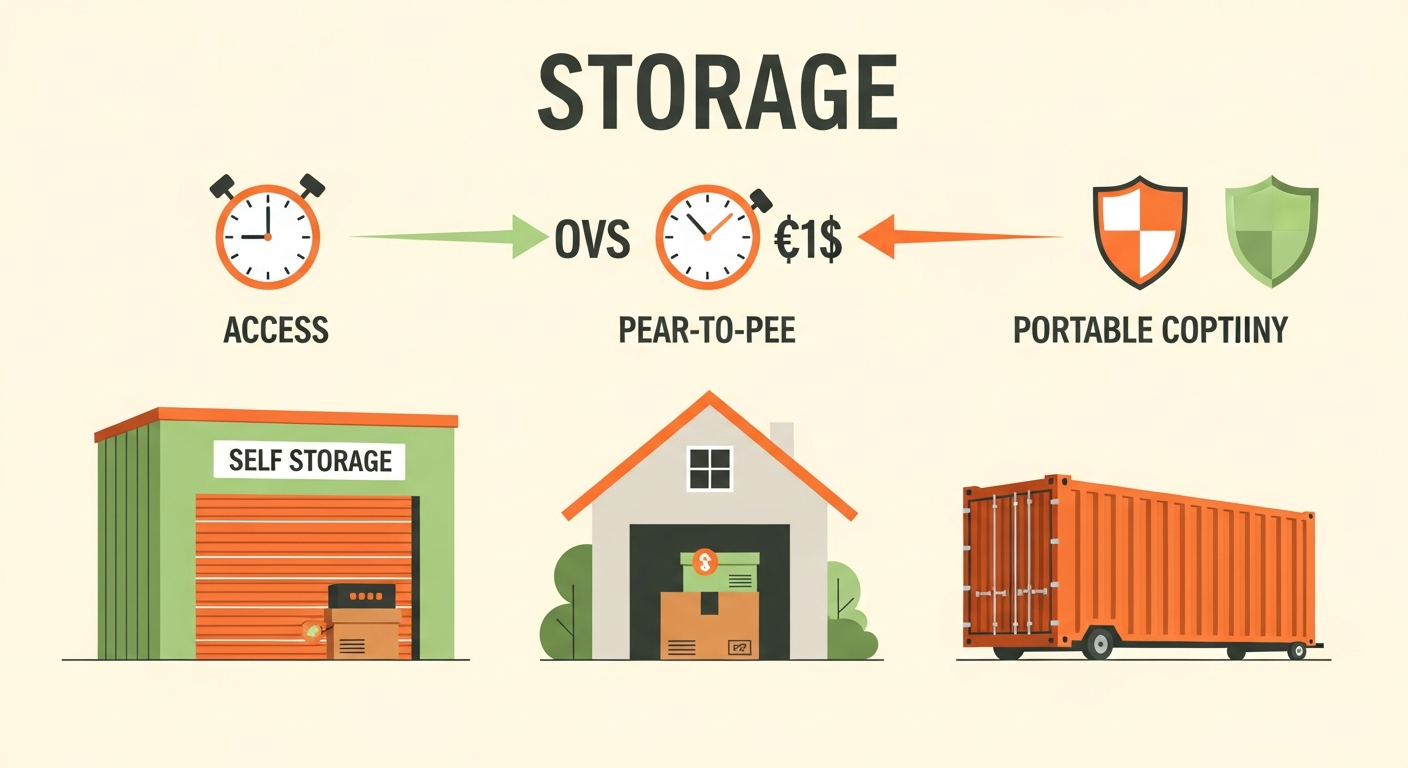
[B4] Three categories, and most people only seriously consider one.
|||
[B5] Traditional self-storage facilities. Purpose-built commercial facilities with rows of units, gated access, on-site management, and standardized security. The default option, and still the right one in specific cases covered below.
|||
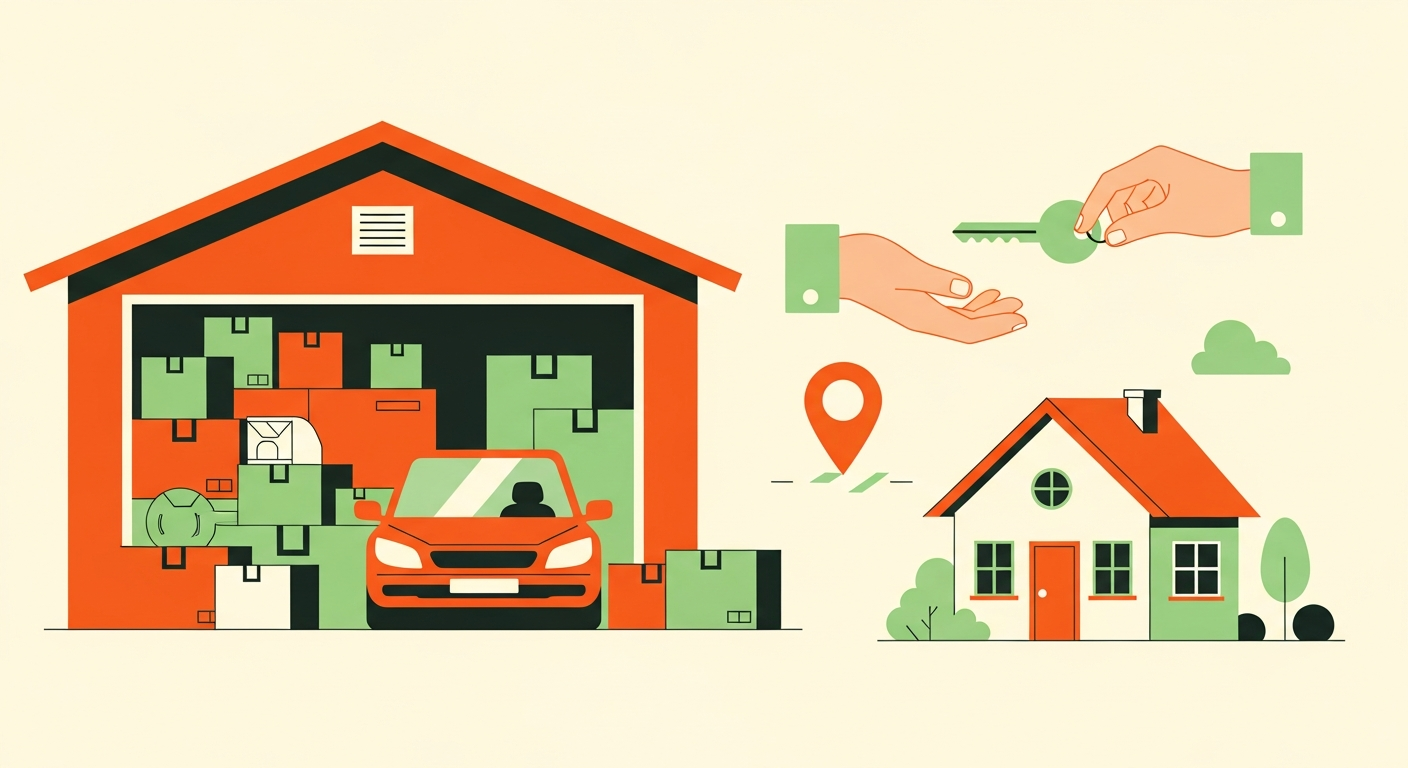
[B6] Peer-to-peer storage platforms. Peer-to-peer storage means renting space directly from an individual -- their garage, driveway, basement, spare room, or RV pad -- through a marketplace like Neighbor. Typically cheaper and closer to home, with more variation between listings. How Neighbor storage works walks through the model in detail if it's new to you.
|||
[B7] Portable storage containers. A portable storage container is delivered to your address, you load it at your own pace, and the company either leaves it on your property or hauls it to their warehouse. Useful specifically when the loading logistics are your problem, not the storage itself.
|||
[B8] The reason peer-to-peer often doesn't surface in a basic search: individual listings don't advertise the way facilities do. You have to look on the platform directly, which is exactly why a lot of people never compare it at all.
|||
[B9] ## How Pricing Compares and What Drives the Difference
|||
[B10] Peer-to-peer is usually the cheapest of the three, and the reason is structural rather than promotional. An individual with an unused garage has no facility to build, staff, insure, or heat. Their marginal cost of renting that space is close to zero, so they can price well below a facility that has to cover real overhead.
|||
[B11] Traditional facilities sit in the middle, with the price reflecting genuine infrastructure -- gates, cameras, staff, climate systems, insurance. You're paying for that, and sometimes it's worth paying for.
|||
[B12] Portable containers are typically the most expensive per unit of space, because you're paying for delivery, pickup, and often transport to a warehouse. The premium buys logistics, not storage.
|||
[B13] Watch for the things that aren't in the headline rate on any of them: facility administration fees, mandatory insurance purchase, promotional first-month rates that step up sharply, and on peer-to-peer, the platform's processing fee reflected in your total. Compare final monthly costs across your actual local options, not advertised starting rates.
|||
[B14] ## Access Hours and Convenience
|||
[B15] This is where the categories differ most, and it's the factor people most often discover too late.
|||
[B16] Traditional facilities usually offer standardized access hours, frequently extended or 24/7 at larger operations. Predictable, and the same whichever unit you rent. If you need reliable access at odd hours, this consistency is a real advantage.
|||
[B17] Peer-to-peer spaces vary entirely by host. Access hours -- the times a host permits you to reach your belongings -- range from full 24/7 access to specific windows or advance-notice arrangements. Some hosts are more flexible than any facility; others are considerably more restrictive. You have to check each listing individually, and this is the single most important thing to confirm before booking.
|||
[B18] Portable containers are the most and least convenient at once. Loading at your own driveway is unbeatable. But once the container goes to a warehouse, retrieving anything usually means scheduling a delivery, which makes casual access impractical.
|||
[B19] Location cuts against the facility advantage, though. A peer-to-peer space five minutes away with 9am-9pm access is often more usable in practice than a 24/7 facility thirty minutes out. Weigh proximity alongside hours rather than treating hours alone as the convenience score.
|||
[B20] ## Security and Insurance
|||
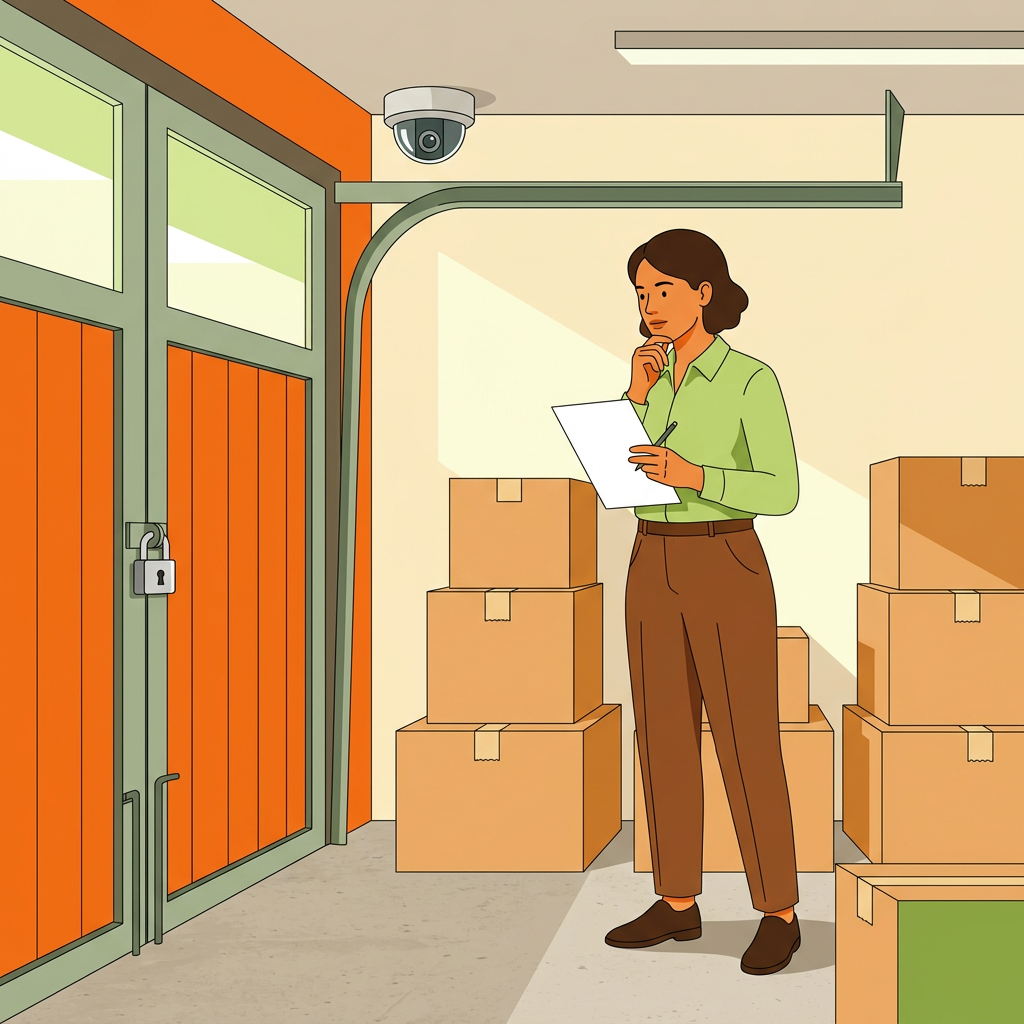
[B21] Facilities offer standardized security: gated access, surveillance, on-site staff, individual locks, sometimes alarms. Consistent across units, which is the point. Most also either offer or require a tenant insurance product.
|||
[B22] Peer-to-peer spaces vary by listing, and the variation runs in both directions. A locked private garage behind a gate in a residential neighborhood is arguably more secure than a unit in a large facility with many people coming and going. An open driveway is clearly less so. Read the specific listing's security features rather than judging the category. Platforms typically include a host guarantee -- protection covering certain damage and loss scenarios, subject to specific terms and limits -- but check what it actually covers and whether the limits match what you're storing.
|||
[B23] Portable containers are secure while sealed, with the meaningful variable being whether the container sits on your property or in a monitored warehouse.
|||
[B24] The honest summary: facility security is predictable, peer-to-peer security is variable but sometimes better. Neither is universally safer. Neighbor storage safety tips covers protecting your belongings whichever you choose.
|||
[B25] ## The Comparison Table
|||
[B26] | Factor | Self-Storage Facility | Peer-to-Peer | Portable Container | |---|---|---|---| | Typical cost | Middle | Lowest | Highest | | Access hours | Standardized, often 24/7 | Varies entirely by host | Limited once stored off-site | | Security | Standardized, predictable | Varies by listing; sometimes better, sometimes worse | Sealed container; depends on storage location | | Proximity | Often further out, commercial areas | Usually closer, residential | Delivered to you | | Flexibility | Month-to-month standard | Varies by host agreement | Tied to delivery scheduling | | Best for | High-value items, guaranteed access, predictability | Cost savings, proximity, vehicle storage | Moves where loading logistics are the hard part |
|||
[B27] Compare your actual local options against these dimensions -- a specific facility or listing near you may not match its category's typical profile.
|||
[B28] ## What to Check on a Peer-to-Peer Listing
|||
[B29] Here's the operator-level knowledge a typical consumer storage guide won't give you: a peer-to-peer listing's details signal how reliable the host is, and reading those signals is most of what separates a smooth rental from a frustrating one. None of this applies when renting from a facility, where you're dealing with a company rather than a person.
|||
[B30] Host response rate and speed. A host who replies quickly to a pre-booking question replies quickly when you need something later. Message them before booking specifically to test this -- the speed and clarity of the answer is genuinely diagnostic.
|||
[B31] Review history and pattern. Not just the rating. Read what recent reviews mention: access reliability, communication, whether the space matched its description. Neighbor renter reviews covers reading these patterns properly.
|||
[B32] Specificity of access instructions. Underrated and highly predictive. A listing that spells out exactly how you get in -- gate code, which door, where to park, what hours -- reflects a host running this seriously. A vague listing usually means friction later.
|||
[B33] Photo quality and honesty. Clear, well-lit photos of the actual space rather than a flattering corner. If the photos don't show you what you're getting, ask for more before booking.
||| [B34] Stated dimensions and access route. Confirm not just that your belongings fit, but that they fit through the entrance and around the corners. This is the most common practical problem. ||| [B35] ## Worked Example One: Short-Term Moving Storage ||| [B36] You're between homes for six weeks and need somewhere for a household's worth of furniture. ||| [B37] What matters: short commitment without penalty, enough space, and easy loading and unloading. Ongoing access barely matters -- you're loading once and unloading once. ||| [B38] Peer-to-peer: strong fit. Cheapest option, likely close by, and access hours matter little for two loading events. Check the access route works for a moving truck, and confirm the host's terms on a short rental. ||| [B39] Facility: workable and predictable, month-to-month is standard, but you're paying facility pricing for infrastructure you barely use in six weeks. ||| [B40] Portable container: genuinely competitive here, despite the highest price. If loading is your hard problem -- no truck, no help, a tight schedule -- having the container arrive at your door and leave loaded solves the actual constraint. Worth the premium when logistics, not storage, is the bottleneck. ||| [B41] The read: peer-to-peer if you have moving logistics handled, portable container if you don't. A facility is the middle option that wins on neither dimension for this particular need. ||| [B42] ## Worked Example Two: Long-Term Recurring Storage ||| [B43] You need somewhere to keep a boat, a motorcycle, or seasonal equipment indefinitely, accessing it a handful of times a year. ||| [B44] What matters: cost, since this runs for years. Access route for a vehicle. Security appropriate to the item's value. Access hours matter moderately -- a few times a year, but you want them to be workable. ||| [B45] Peer-to-peer: usually the clear winner, and vehicle storage is one of its strongest categories. Driveways and RV pads are cheap relative to facility vehicle storage, and a host with a suitable space is often nearby. Over years, the cost difference compounds substantially. A Neighbor vehicle storage renter guide covers the vehicle-specific checks. ||| [B46] Facility: worth it if the item is high-value enough that dedicated commercial security materially reduces your risk, or if you need guaranteed 24/7 access and no local host offers it. ||| [B47] Portable container: poor fit. You're paying delivery logistics repeatedly for something that just needs to sit somewhere. ||| [B48] The read: peer-to-peer for most long-term vehicle and equipment storage, with a facility justified specifically by high value or an access requirement no host meets. Do check the host's terms on long rentals and confirm the space stays available -- a multi-year arrangement deserves an explicit conversation. ||| [B49] ## When a Traditional Facility Is Still the Better Choice ||| [B50] Being honest about this matters, because a one-sided comparison doesn't help you decide: ||| [B51] Very high-value items. If what you're storing is valuable enough that dedicated commercial security and higher coverage limits genuinely matter, a facility's standardized infrastructure and insurance products are the safer choice. Peer-to-peer protection has limits that may not match a high-value load. ||| [B52] Guaranteed 24/7 access. If you need reliable middle-of-the-night access and no local host offers it, that's decisive. Don't book a space with restricted hours hoping the host will be flexible. ||| [B53] Climate control where local options are thin. Facilities reliably offer it; peer-to-peer availability depends on whether a nearby host happens to have it. ||| [B54] Predictability over price. If you want a known, standardized product with no listing-by-listing evaluation, a facility delivers exactly that. That's a legitimate preference. ||| [B55] For a direct head-to-head against a specific major facility option, peer-to-peer storage vs U-Haul goes deeper. ||| [B56] ## Frequently Asked Questions ||| [B57] How does insurance differ between a facility and a peer-to-peer host? Meaningfully, and it's worth understanding before you book. Facilities typically offer or require a tenant insurance product covering your belongings, purchased separately, with coverage you select. Peer-to-peer platforms typically include a host guarantee -- but that protection is structured around specific scenarios with defined limits, and it's oriented toward the arrangement rather than functioning as a full insurance policy on your goods. For anything high-value, check the actual limits and consider your own coverage, since your homeowner's or renter's policy may extend to off-site belongings. Confirm rather than assume in both cases. ||| [B58] What if a peer-to-peer space doesn't match its listing description? Raise it with the host through the platform immediately, before moving anything in -- most discrepancies are honest mistakes about dimensions and get resolved. If it can't be resolved, contact platform support promptly rather than proceeding and complaining later. This is exactly why you photograph the space and your items at move-in and keep all communication in the app: a documented record is what makes a dispute resolvable. Check the cancellation terms before booking too, so you know your position if the space genuinely isn't usable. ||| [B59] Is peer-to-peer storage actually cheaper, or is that marketing? Genuinely cheaper in most markets, for a structural reason: individuals renting out unused space carry none of a facility's overhead. The exact gap varies by market and listing, so compare actual local prices rather than trusting a general claim -- but the underlying economics do favor peer-to-peer. ||| [B60] Can I access my belongings whenever I want with peer-to-peer storage? Only if the listing says so. Access hours are set by each individual host and range from 24/7 to fairly restricted windows. This is the biggest operational difference from a facility and the thing most worth confirming before you book, especially if you'll need frequent access. ||| [B61] What's the biggest mistake people make choosing storage? Not measuring properly, and not checking the access route. A space with adequate square footage but a narrow entrance or a low garage door doesn't fit your sofa. Measure your largest item, including through-doorway clearance, before you commit anywhere. ||| [B62] Should I use a portable container instead? Only if loading logistics are your actual problem. It's the most expensive per unit of space, and that premium buys delivery and pickup. For a move where you lack a truck or help, it's often worth it. For long-term storage of something that just needs to sit, it isn't. ||| [B63] How do I compare options if listings vary so much? Compare on final monthly cost, access hours, security features, and distance -- for each specific option, not each category. A great facility and a poor peer-to-peer listing exist in the same market as a great peer-to-peer listing and a poor facility. The category tells you what to expect; the specific listing tells you what you're getting. ||| [B64] ## The Takeaway ||| [B65] Renting storage space near you means comparing three real categories, not defaulting to whichever facility ranks first: peer-to-peer is usually cheapest and closest but varies listing by listing, a facility buys predictable security and access that matters for high-value items, and a portable container solves loading logistics at a premium. Measure your belongings, confirm access hours and the access route, and compare final monthly costs across actual local options before booking. ||| [B66] One last aside: a fair number of people who work through this comparison end up looking at their own garage differently once they see what hosts charge for space they weren't using. If that thought lands, the Neighbor.com host earnings guide is where the host side of Sharing Economy picks up.