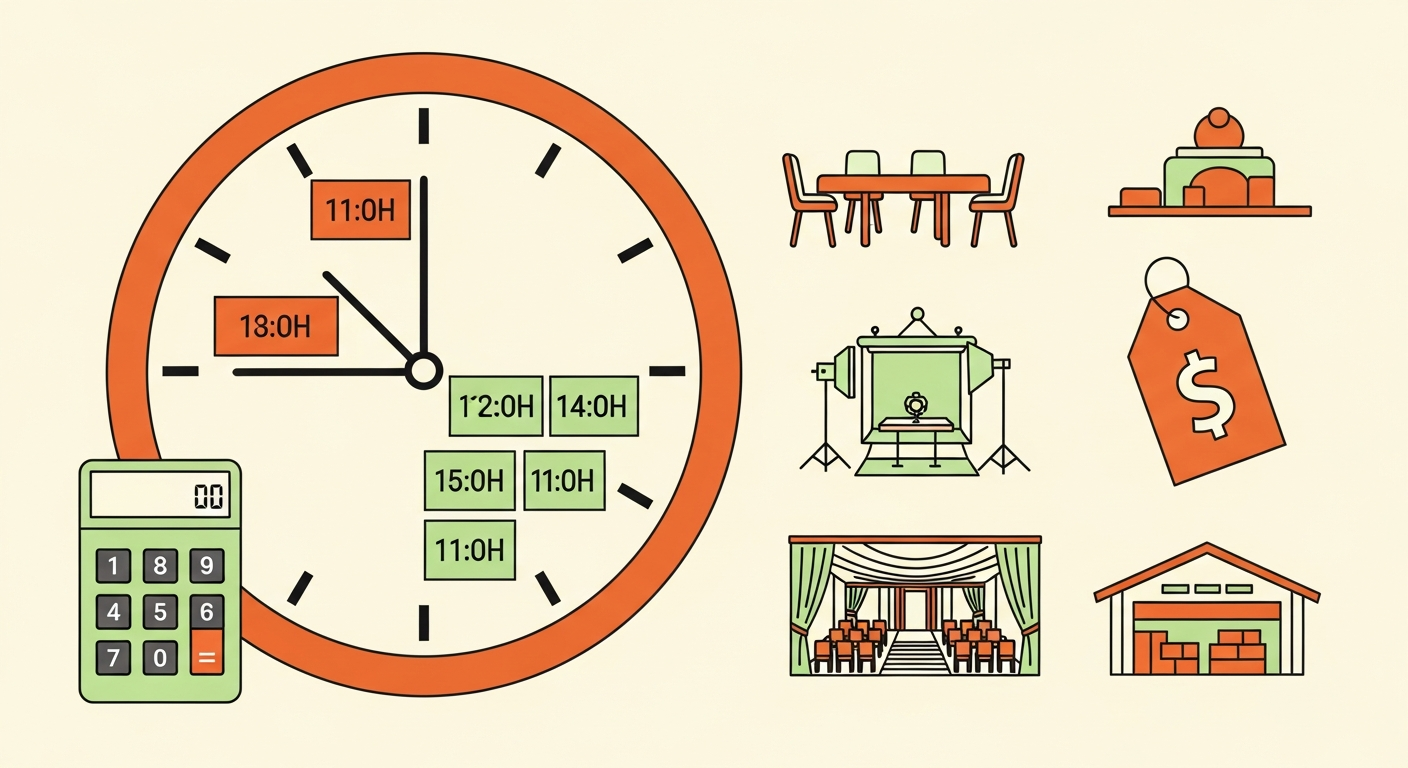
Peerspace pricing has three main parts: an hourly rate set by the host, a service fee added on top at checkout, and possible add-ons like equipment or extra hours. The hourly rate is what varies most -- by space type, city, and what you're using the space for. This guide breaks down each component, walks through two real booking scenarios end to end, and gives you the ranges to budget an actual booking rather than guess.
If Peerspace is new to you: it's a marketplace for booking spaces by the hour -- photo studios, event venues, meeting rooms, and hourly production space (a location rented specifically for a shoot rather than an event or overnight stay) -- from individual hosts. Because hosts set their own prices, the same kind of space can cost very differently depending on who owns it and how they price. All figures here are general patterns; confirm actual rates, fees, and minimums at booking, since they vary by host, space, and city.
How the Base Hourly Rate Varies
The hourly rate is the host-set price per hour, and it's the biggest driver of your total. It swings on three factors.
Space type. A bare-bones meeting room, a fully-equipped photo studio, and a large event venue occupy completely different price tiers. Equipment, size, and production value all push the rate up. A studio with lighting rigs and backdrops costs more per hour than an empty room precisely because you're renting the equipment along with the space.
City. Location drives rate heavily. A major metro with high demand and high real estate costs runs well above a smaller market for a comparable space. The same studio setup can differ substantially between cities.
Neighborhood and uniqueness. Within a city, a distinctive or centrally-located space commands more than a generic one further out. Character costs -- a space with a recognizable aesthetic prices above a plain one.
Here's operator-level insight a typical guide won't mention: hosts often set rates by looking at comparable local listings, and many adjust based on demand, so a listed rate isn't always fixed. This matters for negotiation, covered later -- but the short version is that a listed hourly rate reflects a host's pricing choice, not a platform-standard price, which is exactly why two similar spaces nearby can differ so much.
What the Service Fee Adds
The service fee is a charge the platform adds on top of the host's rate, typically calculated as a percentage of the booking subtotal. It's shown before you confirm, but it's easy to overlook when you're comparing listed hourly rates in your head.
The practical consequence: the hourly rate you see in search is not your real per-hour cost. Add the service fee to get your true number. When comparing two spaces, compare the all-in totals at checkout, not the headline hourly rates -- a lower-rate space with the fee applied might land close to a higher-rate one, or the gap might widen. Always run both to checkout to see the real comparison.
Common Add-Ons and When They're Worth It
Hosts frequently offer add-ons beyond the base space, and whether they're worth paying for depends entirely on your use case.
Equipment. Lighting, backdrops, sound systems, furniture. For a shoot, renting the host's on-site lighting is often far cheaper and easier than transporting your own -- usually worth it. For a simple meeting, you likely need none of it.
Extended or early hours. Access outside the standard booking window, useful for setup and breakdown time. If your shoot needs an hour to set up before you actually start shooting, paying for that hour beats rushing -- and beats getting charged awkwardly for running over.
Cleaning fees. More common on larger event bookings, sometimes a flat charge for events above a certain size. Factor this into event budgets specifically; it rarely applies to a small meeting or a two-person shoot.
Additional guests or capacity. Some spaces charge based on headcount above a threshold, relevant for events.
The rule: add-ons that directly serve your use case (studio lighting for a shoot, setup time for an event) usually pay for themselves in convenience. Add-ons you're tempted by but don't strictly need are where budgets quietly inflate.
How Minimum Booking Hours Affect Your Real Cost
This is the single most overlooked cost factor for short bookings. Minimum booking hours are the fewest hours a host will accept for a reservation -- commonly two or more.
For a short shoot or a one-hour meeting, the minimum can mean paying for more time than you use. A one-hour meeting in a space with a two-hour minimum costs two hours, full stop. This dramatically changes the real per-use cost of a short booking, and it's why the headline hourly rate can mislead.
Always check the minimum before assuming a short booking is cheap. A space with a lower hourly rate but a higher minimum can cost more for a short use than a higher-rate space with no minimum. For short bookings specifically, the minimum matters more than the rate.
How Cancellation and Rescheduling Work
Cancellation policies on Peerspace are partly host-set and vary by listing, similar to how other marketplace platforms handle it. The financial implication depends on the specific policy and how far ahead you cancel.
Some hosts offer flexible cancellation with a full refund up to a cutoff; others are stricter, especially for larger event bookings where they're turning away other business to hold your date. Rescheduling terms similarly vary -- some hosts accommodate it easily, others treat it as a cancellation.
The practical advice: read the specific cancellation and rescheduling policy before booking, particularly for an event where your plans might shift or where a large sum is at stake. For a booking with real money on the line, the cancellation terms are as important to check as the price.
How Costs Compare Across Use Cases
The same physical space can be priced and used very differently depending on purpose, which is why comparing costs means thinking in use cases, not just space types.
Photography and video production. Often billed at studio or production rates, with equipment add-ons common. Shorter durations but higher hourly rates and more likely to need lighting/equipment. Peerspace photography studio rental covers this use case specifically.
Small events. Longer bookings (half-day or full-day), potential cleaning fees, capacity-based charges, and stricter cancellation. The hourly rate might be moderate but the total climbs with duration and event-specific add-ons. Peerspace event space rental goes deeper here.
Meetings and workshops. Usually the most economical -- lower hourly rates for functional spaces, fewer add-ons, though minimum booking hours can still inflate a short meeting's cost.
The same room listed for all three might carry different effective costs because the add-ons, durations, and fees that attach to each use differ.
Cost Breakdown by Space Type
General ranges to frame a budget -- confirm actuals at booking, since host, space, and city all move these:
| Space Type | Base Hourly Rate | Service Fee | Common Add-Ons | Realistic Total Range |
|---|---|---|---|---|
| Meeting room | Lowest tier | % on top | Rarely needed | Lowest, but minimum hours can inflate short bookings |
| Photo/video studio | Mid-to-high tier | % on top | Lighting, equipment, extra hours | Moderate to high; equipment adds up |
| Small event space | Mid tier, longer bookings | % on top | Cleaning fee, capacity charges | Higher total via duration + event fees |
| Large event venue | Highest tier | % on top | Cleaning, staffing, capacity | Highest; total driven by size and add-ons |
The pattern: meeting rooms have the lowest headline rate but minimums can dominate a short booking; studios carry equipment costs; event spaces climb through duration and event-specific fees.
Worked Example One: A Short Photo Shoot
A two-hour portrait shoot in a mid-tier studio.
- Base rate: studio hourly rate x 2 hours (assume the studio's two-hour minimum matches your need exactly -- convenient).
- Lighting add-on: the studio offers on-site lighting for a flat add-on. You take it rather than hauling your own -- worth it.
- Service fee: a percentage on the subtotal, added at checkout.
- Total: base (2 hrs) + lighting add-on + service fee.
The read: the shoot is efficient because your duration matched the minimum and the equipment add-on saved you transporting gear. The service fee is the piece first-timers forget -- budget for it from the start. Where costs would have inflated: if the minimum had been three hours, you'd have paid for an hour you didn't use.
Worked Example Two: A Half-Day Event
A five-hour afternoon event in a small event space.
- Base rate: event-space hourly rate x 5 hours.
- Setup hours: you add an early-access hour for setup and pay for it rather than scrambling -- worth it for an event.
- Cleaning fee: the host charges a flat cleaning fee for events, common at this size.
- Service fee: percentage on the subtotal.
- Total: base (5 hrs) + setup hour + cleaning fee + service fee.
The read: the event total is driven by duration and event-specific fees (cleaning, setup) far more than by the hourly rate alone. This is why event budgets need the add-ons modeled in from the start -- the hourly rate is maybe half the story. And because a real sum is committed, the cancellation policy here matters: check it before booking, since an event host holding your date may have stricter terms than a studio would.
Frequently Asked Questions
Are Peerspace rates negotiable?
Sometimes, particularly for longer or repeat bookings. Because hosts set their own rates and want their space booked, many are open to a conversation for a multi-day booking, a recurring need, or an off-peak slot -- similar to how any individual operator might flex on price for guaranteed volume. It's never guaranteed, but for a substantial or repeat booking, messaging the host to ask is reasonable and often works. For a single short booking at peak demand, expect less flexibility.
What's the real difference between the listed rate and what I pay?
The service fee, plus any add-ons and the effect of minimum booking hours. The listed hourly rate times your hours is only the starting point -- add the service fee, any equipment or hour add-ons, and account for the minimum. Always run a booking to checkout to see the true total before comparing spaces.
How do minimum booking hours affect a short booking?
Significantly. A space with a two- or three-hour minimum charges you that minimum even for a one-hour need, which can make a lower-rate space with a high minimum more expensive than a higher-rate space without one. For short bookings, check the minimum before the rate.
Does pricing differ for commercial production versus a personal event?
It can. Some hosts price or gate commercial production use differently from a personal shoot or event, since commercial productions may bring more equipment, crew, and wear -- and some hosts explicitly welcome or restrict certain use types. If your use is a commercial production, confirm the host allows it and whether the rate differs, rather than assuming the listed personal-use rate applies.
Why do two similar spaces near each other cost so differently?
Because each host sets their own rate based on their read of local demand, their space's features, and their own pricing strategy. There's no central platform price. This is exactly why comparing several listings for the same need is worth the effort -- the price spread for comparable spaces can be wide.
What add-ons are actually worth paying for?
The ones that serve your specific use: studio lighting for a shoot (cheaper than transporting your own), setup hours for an event (beats rushing or overrunning). Skip the ones you're tempted by but don't strictly need -- that's where budgets quietly inflate.
Should I budget for a cleaning fee?
For events, often yes -- flat cleaning fees are common on larger event bookings. For a small meeting or a two-person shoot, usually not. Check the listing's fee structure, since it varies by host and scales with the kind of use.
The Takeaway
A realistic Peerspace rental cost guide comes down to four things beyond the headline hourly rate: the service fee added at checkout, add-ons that fit your use case, the minimum booking hours that can inflate a short reservation, and the event-specific fees that drive event totals. Run any booking to checkout for the true all-in number, check the minimum and cancellation policy before committing, and compare several listings since host-set pricing varies widely.
One last aside: plenty of people who book Peerspace regularly for shoots or events eventually look at the space they already have and wonder whether it could earn on the other side of the platform. If that thought ever lands, the Peerspace host earnings guide is where the host side of SharingShell picks up.