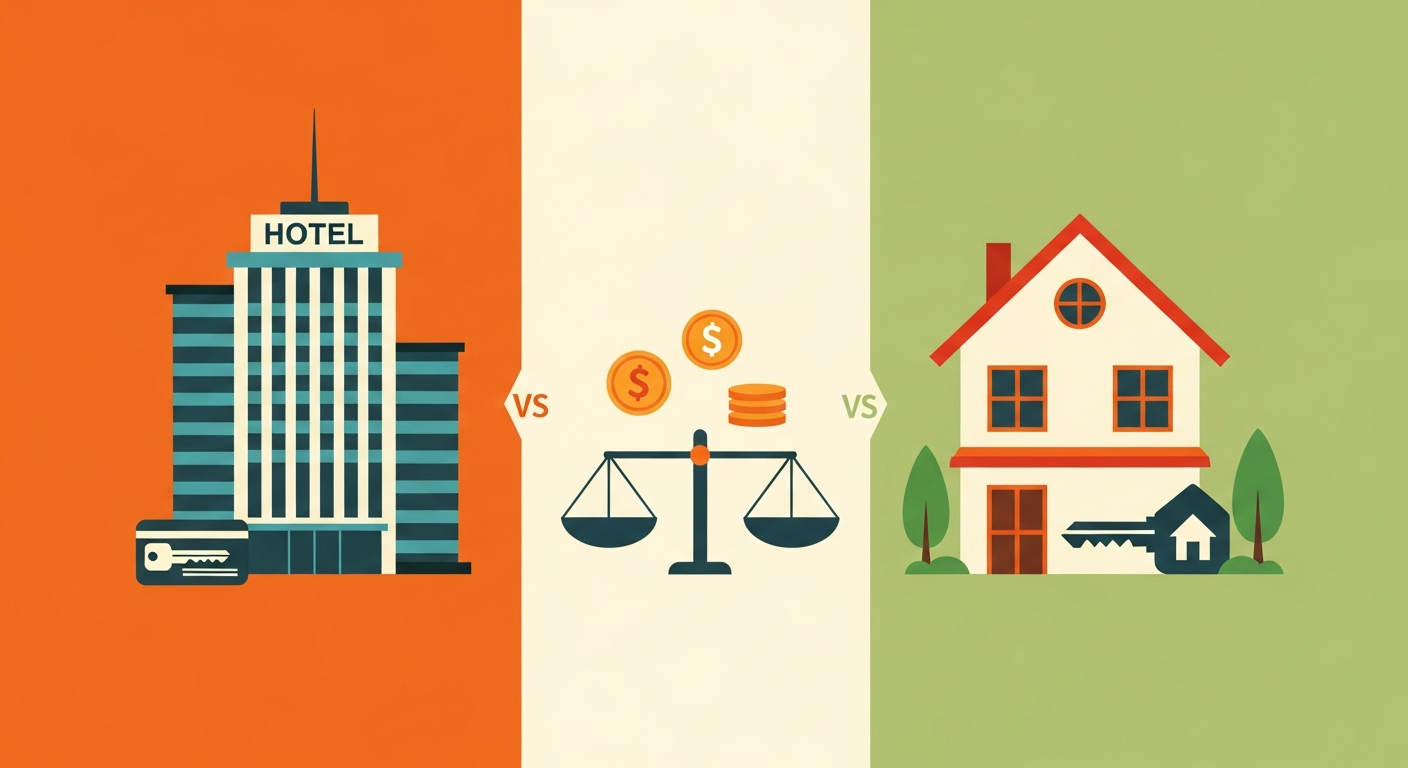
[B1] Is an Airbnb cheaper than a hotel? It depends heavily on trip length and group size — Airbnb tends to win on longer stays and group travel where you split a whole unit, while hotels often win on single nights and last-minute bookings. The reason comes down to how each one's fees are structured, and the fixed fees on an Airbnb can quietly erase its advantage on short stays. This guide breaks down both cost structures honestly so you can tell which wins for your specific trip.
|||
[B2] Both options advertise a nightly rate that isn't what you actually pay. Understanding the full stack of fees on each side is the whole game, so let's break them down. Note that specific fees, taxes, and rates vary widely by market, host, and hotel brand, so always check the final total at booking rather than trusting an advertised rate.
|||
[B3] ## How Airbnb's Total Cost Is Actually Structured
|||
[B4] An Airbnb's advertised nightly rate is only the starting point. The total is built from several components that combine in a way that penalizes short stays specifically.
|||
[B5] Nightly rate (host-set). Each host sets their own nightly price, which is why comparable listings in the same area can differ significantly. Some hosts price competitively to stay booked; others price high and rely on fewer bookings. Many adjust prices by season and demand.
|||
[B6] Cleaning fee. A cleaning fee is a one-time charge added per stay, not per night, to cover turnover cleaning. This is the single most important fee to understand, because it doesn't scale with stay length. A cleaning fee spread across one night is brutal per-night math; spread across seven nights it nearly disappears. This is precisely why Airbnb often loses on short stays and wins on longer ones.
|||
[B7] Service fee. A service fee is a charge the platform adds, typically calculated as a percentage of the subtotal. It's shown before you book but is easy to overlook when comparing against a hotel's advertised rate.
|||
[B8] Taxes. Occupancy taxes often apply, varying by location.
|||
[B9] Here's the operator-level insight a typical travel blog misses: because the cleaning fee is fixed per stay, the real per-night cost of an Airbnb drops sharply the longer you stay. A listing that looks expensive for two nights can be a bargain for seven — the advertised nightly rate tells you almost nothing until you add the fixed fees and divide by your actual number of nights.
|||
[B10] ## How Hotel Pricing Is Structured
|||
[B11] Hotels have their own layer of fees beyond the headline rate.
|||
[B12] Nightly rate. Set by the hotel, varying by demand, season, and how far ahead you book.
|||
[B13] Resort or facility fees. Some hotels add a mandatory daily fee (sometimes called a resort fee) covering amenities whether you use them or not. Unlike an Airbnb cleaning fee, this one is usually per night, so it scales up with stay length rather than down.
|||
[B14] Taxes. Occupancy and tourism taxes, often a meaningful percentage, typically apply per night.
|||
[B15] Parking and incidentals. Parking can carry a significant daily charge, especially in cities, and is easy to forget when comparing against an Airbnb that may include free parking.
|||
[B16] The hotel advantage is consistency and per-night predictability: no fixed cleaning fee means a single night isn't penalized the way it is on Airbnb.
|||
[B17] ## A Realistic Side-by-Side Cost Scenario
|||
[B18] Consider a hypothetical multi-night stay for a small group in a mid-demand city. The figures below illustrate how the cost structures compare, not current prices, which vary by market, host, and brand and should be checked at booking.
|||
[B19] | Cost Component | Airbnb | Hotel | |---|---|---| | Base rate | Host-set nightly, varies widely | Brand-set nightly, more consistent | | Fixed per-stay fee | Cleaning fee (doesn't scale with nights) | None equivalent | | Per-night add-on fee | Generally none beyond nightly rate | Resort/facility fee (scales with nights) | | Service fee | Platform percentage of subtotal | Generally none | | Taxes | Occupancy tax, varies | Occupancy/tourism tax, varies | | Parking | Often included | Often extra, especially in cities | | Cancellation | Host-set policy, varies by listing | Often flexible, varies by rate type |
|||
[B20] The pattern this reveals: Airbnb's fixed cleaning fee and the potential to split one unit among a group favor longer stays and larger groups, while a hotel's per-night fee structure and lack of a fixed cleaning charge favor short stays and solo or couple travelers.
|||
[B21] ## Where Airbnb Tends to Come Out Cheaper
|||
[B22] Longer stays. The fixed cleaning fee spreads thinner each added night, and many hosts offer weekly or monthly discounts. For extended trips, Airbnb frequently wins, and Airbnb long-term stay discounts can widen that gap further.
|||
[B23] Group travel. Splitting one whole unit among several people often beats booking multiple hotel rooms. The more people sharing the space, the stronger Airbnb's math. [L60] (Note: the original text for B24 follows). [B24] Kitchen access. A kitchen lets you cook instead of eating every meal out, which can cut a trip's total food cost substantially — a real saving hotels rarely match. This is part of why Airbnb appeals for family travel; *Best Airbnb Booking Tips* touches on choosing well for that. [B25] Space needs. For families or groups needing multiple bedrooms and common space, a whole home often costs less than equivalent hotel rooms. [B26] ## Where Hotels Tend to Win [B27] An honest comparison has to be clear that hotels frequently win. [B28] Single-night stays. This is the big one. The Airbnb cleaning fee lands entirely on a one-night stay, often making a hotel cheaper outright for a quick overnight. Hotels have no equivalent fixed per-stay penalty. [B29] Last-minute bookings. Hotels are built to absorb last-minute demand at a counter, while Airbnb's short-notice availability is thinner and minimum-stay rules can block a one-night booking entirely. [B30] Service consistency. A hotel delivers a predictable, standardized experience — daily housekeeping, a front desk, guaranteed amenities. Airbnb quality varies by host and property, so you're partly betting on a specific listing. [B31] Simplicity and amenities. No self-check-in coordination, no host communication, no turnover responsibilities like taking out trash at checkout. For a short, simple trip, that predictability has real value. [B32] ## What Travelers Commonly Overlook [B33] Minimum stay requirements. Many hosts set a minimum stay — the fewest nights they'll accept — which can be two, three, or more nights. This can rule out short trips entirely or force you to pay for nights you don't need, a factor that never appears in a simple nightly-rate comparison. [B34] Cancellation policy differences. Airbnb cancellation terms are partly host-set and vary widely by listing, while hotels often offer more uniform, sometimes more flexible, cancellation. Check the specific policy before booking, especially if plans might change — Airbnb guest cancellation policy explains how the tiers work. [B35] The all-in comparison. The most common mistake is comparing an Airbnb's nightly rate against a hotel's nightly rate. Always compare the final all-in totals — every fee, tax, and add-on included, divided by your actual number of nights. *Best Airbnb Booking Tips* covers finding genuine value once you're comparing correctly. [B36] Specific needs. Traveling with a pet or needing particular amenities changes the math on both sides — an Airbnb pet-friendly rental search may reveal fees or restrictions, just as hotels charge pet fees. Factor these in before deciding. [B37] ## FAQ [B38] Is Airbnb always cheaper than a hotel? No. Airbnb tends to be cheaper for longer stays and group travel splitting a whole unit, but the fixed cleaning fee often makes a hotel cheaper for single nights and short stays. Compare the all-in total for your specific trip rather than assuming either is always cheaper. [B39] Why is the Airbnb cleaning fee such a big deal? Because it's charged once per stay, not per night. On a one-night booking, the full cleaning fee lands on that single night, inflating the real per-night cost dramatically. Over a longer stay it spreads thin and barely matters, which is why stay length changes the comparison so much. [B40] Do hotels have hidden fees like Airbnb? Yes, just different ones. Resort or facility fees, occupancy taxes, and parking charges can meaningfully raise a hotel's real cost above its advertised rate. The difference is that hotel fees usually scale per night, while Airbnb's biggest fee is fixed per stay. [B41] When does an Airbnb clearly beat a hotel on cost? Longer stays and group travel are the clearest wins, especially when several people split one unit and a kitchen cuts food costs. The longer the stay and the larger the group, the more Airbnb's structure favors you. [B42] What should I watch out for when booking an Airbnb to save money? Minimum stay requirements, the cleaning and service fees, and the cancellation policy. Always calculate the all-in total divided by your number of nights, and don't compare nightly rates alone — the fees are where the real difference hides. [B43] ## The Takeaway [B44] The honest answer to the Airbnb vs hotel cost comparison is that it depends on your trip: Airbnb wins on longer stays and group travel where the fixed cleaning fee spreads thin and a whole unit gets split, while hotels win on single nights, last-minute trips, and when you value consistency. Always compare the all-in total divided by your actual nights, not the advertised nightly rates. [B45] One last aside: plenty of travelers who research stays like this eventually look at the other side of the platform, since the same fee structures that shape these deals are what hosts work with daily. If that curiosity ever strikes, our short-term rental compliance checklist is a practical starting point for the host side of SharingShell.