Booking a space for an event is meaningfully different from booking a photo studio or a meeting room on the same platform. Events add capacity math that isn't as simple as a listed number, noise and curfew rules that aren't always visible in the listing, setup and breakdown time that has to be booked as real hours, and often an insurance requirement the host imposes specifically because of the added liability an event carries. This guide covers each of these in detail, so your event booking doesn't run into a problem a studio booking never would.
If you're new to booking through Peerspace generally, how to book a Peerspace studio covers the basics. This guide is specifically about what changes when you're planning an event rather than a shoot or a meeting.
Evaluating Actual Capacity vs. Comfortable Capacity
A listed capacity number is rarely the number you should actually plan around, and understanding why is the first real skill in booking an event space well.
Listed capacity often reflects a maximum, not a comfortable working number. A space listed for a certain headcount is often describing standing-room or fire-code maximum capacity, not the number of people who'll actually have a comfortable time there with furniture, tables, a bar setup, or a dance floor taking up real space.
Furniture and equipment eat usable space fast. Tables, chairs, a DJ setup, a catering station, a gift table -- every functional element of your event reduces the open floor space available for the headcount you're planning around. A space that comfortably fits its listed capacity empty can feel genuinely cramped once your actual event layout is in it.
Ask the host directly about your specific event type. Rather than trusting the listed number alone, describe your actual plan -- headcount, whether you need seating, tables, a dance floor, a stage or presentation area -- and ask the host what capacity that setup realistically supports. A host who's hosted similar events in the space has real, specific knowledge a generic listed number can't capture.
When in doubt, undershoot. A slightly smaller guest list in a comfortable space beats a maxed-out guest list in a cramped one, for basically every kind of event.
Noise and Neighbor Restrictions
Many event-friendly spaces carry specific rules or curfews that aren't always obvious from the listing alone, and this is one of the most common sources of a disrupted event.
A curfew policy is a defined cutoff time for noise or the event itself, often tied to neighbor complaints, local noise ordinances, or building rules the host has to operate within. Some listings state this clearly; others mention it only when asked, or not until you're already deep into planning.
Why this matters more for events than other Peerspace use cases. A photo shoot or a quiet meeting rarely triggers a noise concern. A party with music, a crowd, and rising volume late in the evening is exactly the scenario curfew policies exist to prevent -- and hitting an unexpected curfew mid-event is a genuinely bad experience for everyone involved.
Ask specifically, before booking, not after. Confirm any noise curfew, whether amplified music or a DJ is permitted, and whether there are specific neighbor-sensitivity considerations (a residential building above or adjacent to the space, for instance) that might affect your event's volume or timing. Don't assume a space that looks like an event venue in photos has unrestricted noise allowances.
Plan your event timeline around the confirmed curfew, not your ideal timeline. If the space has a defined cutoff, build your event schedule to wind down comfortably before it, rather than planning your ideal timeline and hoping the curfew won't matter.
Why Setup and Breakdown Time Needs Its Own Booking Window
This is the mistake that catches more first-time event bookers than almost anything else on this list.
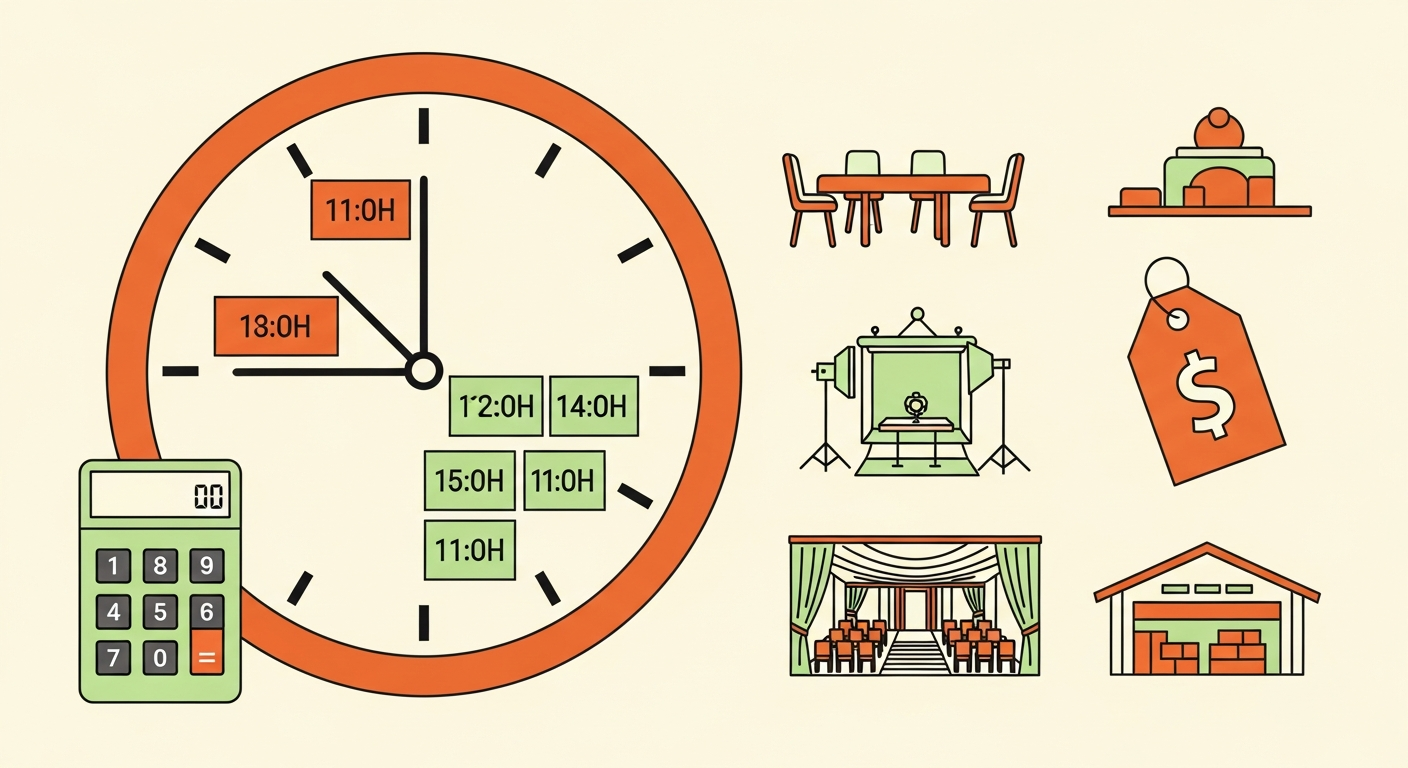
Setup/breakdown buffer is the time needed before and after your actual event to arrange the space and restore it, separate from the event itself. Decorating, arranging furniture, setting up catering or a bar, testing AV equipment -- all of this takes real time and has to happen before guests arrive. Afterward, breakdown -- cleanup, removing decor, resetting furniture -- takes real time too.
The booking window needs to cover all of it, not just the event's stated hours. If your event runs from a start time to an end time, your actual booking needs to extend before that start time for setup and after that end time for breakdown. Forgetting this is exactly how events end up rushed at the start or scrambling at the end.
Overtime charges are a real cost of underestimating this. If your booking window runs out before breakdown is complete, expect an overtime charge for the extra time -- often at a premium above your booked rate. Building adequate buffer into your original booking is cheaper and less stressful than paying overtime to finish what should have been planned for.
Estimate buffer realistically, not optimistically. A simple gathering needs less setup time than an event with catering, a full bar, decor, and AV equipment. Be honest about your actual event's complexity when estimating how much buffer to book, and round up rather than down.
Event Insurance Requirements
Some hosts require proof of insurance for events specifically, even when they don't require it for a studio shoot or meeting booked in the same space -- and understanding why makes the requirement feel less like an obstacle and more like a reasonable precaution.
Event insurance is coverage specifically addressing the liability an event creates -- more people, alcohol in some cases, activities with genuine injury or property-damage risk that a quiet shoot or meeting doesn't carry to the same degree.
Why hosts require this for events specifically. From the host's side, an event genuinely raises their liability exposure -- more guests, potentially alcohol, more activity, more possibility of an incident. A host requiring proof of event insurance is managing real risk to their property and their own liability, not adding an arbitrary hurdle. Understanding this reframes the requirement from an inconvenience into a reasonable ask given what's actually at stake for the person whose space you're using.
What this typically looks like. Some hosts require a certificate of insurance for the event, sometimes naming the host or venue as an additional insured party for the event's duration. Specific requirements vary significantly by listing, so confirm exactly what a given host needs well before your event date, not the week of.
If you don't already have coverage, it's often available to purchase separately. Event-specific liability insurance can typically be purchased for a single event through various providers, even if you don't carry any ongoing coverage. Research this as part of your planning if a host requires it and you don't already have applicable coverage -- don't wait until close to the event date, since arranging coverage takes some lead time.
Catering, Alcohol, and Vendor Policies
Beyond capacity, noise, and insurance, confirm these specifics before finalizing your booking.
Catering policies. Some hosts allow any outside caterer; others require using an approved vendor list or restrict certain types of food preparation on-site (open flame cooking, for instance). Confirm this before committing to a specific caterer.
Alcohol policies. Whether alcohol is permitted at all, whether it needs to be served by a licensed bartender or caterer rather than self-served, and whether this affects the insurance requirement above. Alcohol policies are one of the most host-specific variables in this entire process -- never assume based on one listing that another allows the same thing.
Outside vendor policies. Confirm whether you're free to bring in your own DJ, decorator, photographer, or other vendors, or whether the host restricts this or requires vendors to meet specific requirements (their own insurance, for instance).
Get all of this in writing. Once confirmed, keep the specifics documented -- a message thread with the host covering capacity, curfew, insurance, and vendor policy is worth having on hand, both for your own planning and as a reference if any question arises closer to the event.
Worked Example One: A Small Gathering
A workshop or small party, roughly 20-30 guests, modest setup needs.
Capacity check: the listing states a maximum well above the guest count, but the host confirms that with a few tables and a presentation area, this headcount will feel comfortable rather than cramped -- appropriately undershooting the listed maximum.
Setup/breakdown estimate: modest -- arranging a few tables, setting up a simple refreshment station, testing basic AV. A shorter buffer window covers this comfortably.
Insurance: the host doesn't require proof of insurance for a gathering this size and low-complexity, though the renter confirms this explicitly rather than assuming.
Cost breakdown: the booked hours (event time plus buffer) at the listing's hourly rate, plus the platform's service fee, with no additional insurance cost given this event's scope. See the Peerspace rental cost guide for how the hourly-rate-plus-fee structure works in detail.
The read: a smaller, simpler event has fewer of the complicating factors this article covers, but the same due-diligence steps -- confirming comfortable capacity, checking any noise expectations, and booking real buffer time -- still apply and still prevent avoidable problems.
Worked Example Two: A Larger Event With Complex Setup
A larger party or celebration, 80-100 guests, catering, a bar, a DJ, and decor.
Capacity check: the listing's maximum capacity is close to the actual guest count, which prompts a direct conversation with the host about whether that number holds once tables, a bar setup, and a dance floor are factored in. The host, drawing on experience with similar events in the space, recommends a somewhat lower comfortable number than the listed maximum -- guidance the renter takes seriously rather than pushing the listed limit.
Noise/curfew check: given the DJ and expected evening volume, the renter confirms the space's specific curfew policy and plans the event timeline -- including winding down the music before the cutoff -- around it explicitly.
Setup/breakdown estimate: substantial -- catering setup, a full bar, DJ equipment testing, and decor all take real time before guests arrive, and breakdown of all of it takes real time after. The booking window is extended well beyond the event's stated hours on both ends to avoid a rushed setup or overtime charges at breakdown.
Insurance: the host requires proof of event insurance given the scale, the alcohol service, and the higher guest count -- a real liability consideration from the host's side. The renter arranges single-event coverage in advance, well ahead of the event date.
Cost breakdown: the extended booking window (event hours plus substantial setup/breakdown buffer) at the hourly rate, the platform's service fee, plus the cost of the required event insurance -- a meaningfully higher total than the smaller gathering, driven by both the longer booking window and the added insurance requirement.
The read: every consideration in this article scales up with event complexity and size. A larger, more complex event needs more careful capacity planning, explicit curfew coordination, substantially more buffer time, and often a real insurance requirement the smaller gathering didn't trigger.
The Pre-Booking Checklist
Work through this before confirming any event booking:
- Confirm comfortable capacity for your specific event setup, not just the listed maximum.
- Ask about noise policies and any curfew explicitly, before finalizing dates.
- Estimate setup and breakdown time honestly, and book that as part of your window, not as an assumption the event hours alone will cover.
- Ask whether the host requires event insurance, and if so, what specifically it needs to cover.
- Arrange insurance in advance if required and you don't already have applicable coverage.
- Confirm catering policy -- approved vendors, restrictions on preparation methods.
- Confirm alcohol policy -- permitted, self-served or licensed-server-only, and how this interacts with insurance.
- Confirm outside vendor policy -- DJ, decorator, photographer restrictions if any.
- Get all confirmed specifics in writing through the platform's messaging.
- Book with adequate total time, including buffer, rather than the event's bare stated hours.
Frequently Asked Questions
Can I purchase event insurance separately if the venue requires it and I don't have coverage?
Generally yes -- single-event liability insurance is commonly available to purchase for exactly this situation, even without any ongoing policy. Research options as soon as you know a host requires it, since arranging coverage takes some lead time and you don't want to be sourcing it the week of your event.
How far in advance do event spaces typically need to be booked compared to smaller studio bookings?
Generally further ahead than a simple studio or meeting room booking, especially for larger events or popular venues and dates. Event spaces with strong demand, particularly for weekend dates, can book up well in advance. Start your search and outreach earlier than you would for a straightforward shoot booking, particularly if your event date has any flexibility constraints.
What happens if my event runs over the booked time?
Expect an overtime charge, often at a premium rate above your booked hourly rate -- and depending on the host's schedule, there may not even be flexibility to extend if another booking follows yours. This is exactly why booking adequate setup and breakdown buffer upfront matters so much; it's cheaper and safer than hoping to extend on the day.
Do all Peerspace event listings require insurance, or only some?
Only some, and it typically depends on the host's assessment of the specific event's risk -- scale, alcohol service, and activity type all factor in. Never assume based on one listing's requirements what another will need. Confirm directly with each host you're considering.
Can I negotiate the noise curfew if my event needs to run later?
Sometimes, but don't assume it's flexible -- some curfews are set by building rules, local ordinances, or neighbor agreements the host genuinely can't override, regardless of what you're willing to pay. Ask directly, but plan your event around the confirmed policy rather than assuming a later cutoff can be negotiated once you're already committed to the space.
What's the biggest difference between booking for a photo shoot versus an event at the same venue?
Liability and complexity. A shoot involves a small crew with predictable, low-risk activity; an event involves more guests, potentially alcohol, more activity, and genuinely higher liability exposure for the host -- which is exactly why insurance requirements, capacity scrutiny, and noise policies apply much more heavily to events than to other Peerspace use cases at the very same venue. The Peerspace photography studio rental guide covers the shoot-specific considerations if that's your actual use case instead.
Should I visit the space in person before booking for a large event?
Strongly recommended for anything beyond a small, simple gathering. Seeing the actual space, its layout, and how your planned setup would realistically fit is far more reliable than judging from photos and a listed capacity number alone -- especially given how much furniture, catering, and a dance floor can change a space's usable feel.
The Takeaway
Booking a Peerspace event space rental well comes down to a handful of details a studio or meeting booking never requires: confirming comfortable capacity for your actual event setup rather than trusting the listed maximum, checking noise and curfew policies before you plan your timeline, booking real setup and breakdown buffer rather than just the event's stated hours, and confirming any event insurance requirement early enough to arrange coverage if needed. Get every specific in writing before your event date, and when in doubt, ask the host directly rather than assuming.
One thing worth noting: hosts who set up their space specifically for events -- clear capacity guidance, transparent noise and vendor policies -- tend to book more reliably and attract fewer last-minute questions from renters like you. If you're curious what that looks like from the other side, our Peerspace host earnings guide covers the host side of SharingShell.