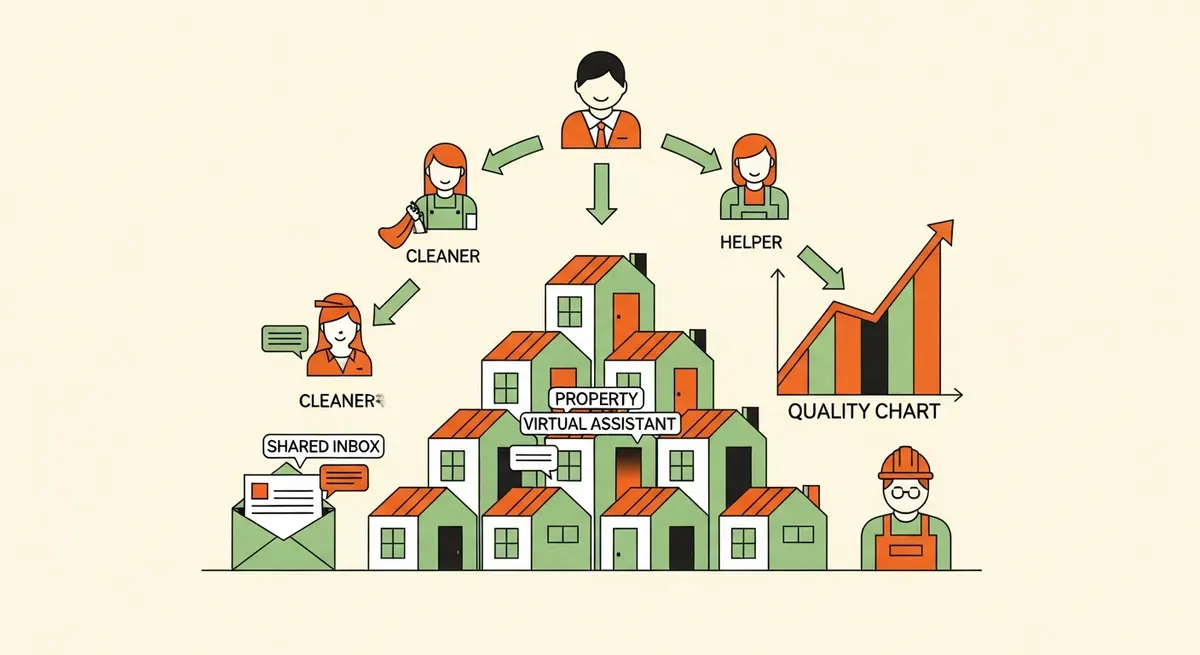
Co-hosting is a service business. You're paid to run someone else's listing, and you don't own the asset or carry its mortgage or lease. The realistic path to becoming a co-host is to start with one or two owners, prove you're reliable, and grow from referrals. Startup costs are low, but the responsibilities are real: you're handling an owner's property, guests, and sometimes money, so the basics need to be done properly from day one.
This guide walks the whole path: what the work involves, how to pick a starting lane, how to structure and price your service, how to set up and land a first client, and which legal and tax steps to complete along the way. It links out to deeper articles on client acquisition, scaling, agreements, insurance, and tax rather than repeating them. Earnings depend on your market, the number of properties, and your service scope, so every number below is an illustrative example, not an expectation. Licensing rules, platform feature terms, and tax treatment vary by jurisdiction and change over time, so verify each locally.
What a Co-Host Actually Does
Day to day, the work falls into five buckets.
Guest messaging. Answering inquiries, sending check-in instructions, handling questions during stays, and managing checkout. This is constant, and response time is a large part of your value.
Calendar and pricing management. Keeping availability accurate, adjusting rates for demand and events, and setting minimum stays within the owner's guidelines.
Turnover coordination. A turnover is the cleaning and reset between one guest's checkout and the next check-in. You schedule cleaners, confirm the property is ready, and handle the cases where it isn't.
Maintenance coordination. Dispatching handymen and vendors, tracking repairs, and keeping the owner informed.
Reviews and issue handling. Responding to reviews, resolving complaints, and escalating anything serious to the owner.
Be honest with yourself about the unglamorous parts. Guests have problems at 11pm. Cleaners cancel the morning of a check-in. A pipe leaks during a stay. Part of the job is staying calm and having a plan for those moments.
What a co-host does not do: own the asset, carry its financing, or keep the property's profit. You earn a fee for operating it. That's why the barrier to entry is low, and also why your income depends entirely on service quality and keeping clients.
Skills and Habits That Matter Most
No prior experience or credentials are required to start. The skills that matter can be built deliberately.
Responsiveness. Fast, clear replies are the core of the job. Set a personal response-time standard (for example, a stated maximum for guest messages) and hold to it.
Systems thinking. The difference between a co-host who copes and one who scales is written systems: a turnover checklist, message templates, an escalation plan for emergencies.
Calm under pressure. Guests who are locked out or upset need clear steps, not panic. Practice by writing out how you'd respond to common problems before they happen.
Record-keeping. Photos, logs, receipts, and a record of every owner decision. Records protect you and the owner.
How to build these without experience: host or help manage a friend's listing at no charge for a short period, study how well-reviewed listings communicate, write your own templates and checklists, and shadow a cleaner on a turnover to learn what "ready" actually means. You'll learn faster than you expect.
Choosing a Starting Lane by Asset Type
Co-hosting applies across asset types, each with a different workload.
Airbnb and short-term rental properties. The largest market and the most familiar. Work includes messaging, pricing, and turnover coordination. See the Airbnb co-hosting rates guide for typical structures.
Turo fleet co-management. Managing vehicles for owners: guest communication, handoffs, turnover, and maintenance scheduling. Handoff logistics and documentation matter more here. See the Turo fleet co-management service article.
Neighbor storage co-management. Tenant communication, access coordination, and unit turnover, typically at lower revenue per unit but lower workload per unit too. See the Neighbor co-management service article.
Peerspace spaces. Hourly bookings with event and production use, different turnover rhythm, and a smaller, less standardized market.
Choosing a lane: start where you can get a first client most easily and where the work suits your schedule. Properties suit people comfortable with guest communication and local vendors. Vehicles suit people who like logistics and documentation. Storage suits people who want a lighter workload per asset. You can add lanes later.
If you'd rather work remotely, virtual co-host services explains what a remote model can cover and where a local contact is still needed.
Deciding What to Offer: Service Tiers
Full-service co-hosting means handling everything from guest communication through pricing, turnover, and maintenance coordination. Starting with a narrower tier is usually smarter.
Messaging-only. Guest messaging, check-in/out logistics, basic triage. Flat monthly fee or low percentage. Low; mostly screen time. Owner with local help but no time to answer messages Mid-tier. Messaging plus calendar, pricing input, and cleaner coordination. Percentage of revenue (revenue share) or hybrid. Moderate. Owner who wants day-to-day relief but keeps final decisions Full-service. Messaging, pricing authority, turnover, maintenance, issue resolution. Higher percentage of revenue. Highest; includes on-call time. Owner who wants hands-off operation
Revenue share means you take an agreed percentage of the property's revenue instead of (or alongside) a flat fee. The co-hosting commission structure and rate guide cover how percentages and flat fees compare. Start with a tier you can deliver reliably. You can always expand scope with a client once trust is established.
Setup Checklist
Setup is mostly small steps. Work through them in order.
- Register the business as the structure you choose, and check local business registration requirements. The asset-sharing business LLC setup guide covers the structure question. Whether you need an entity at the start is worth a short conversation with an accountant or attorney.
- Open a separate business bank account. Keep client money and your own money apart from day one.
- Set up basic software. A shared calendar, a messaging tool, a task list, and a simple spreadsheet cover the start. See co-hosting software tools for when to upgrade.
- Write a service agreement. Never work on a handshake. Use the co-hosting agreement legal template as a starting structure and have a local attorney review it.
- Have the insurance conversation. Ask an insurance professional what coverage you need as a service provider, and what the owner's policy covers. See co-hosting liability insurance.
- Build a trusted vendor network. Identify a primary cleaner, a backup cleaner, and a handyman before you need them.
- Create your standard documents. A turnover checklist, message templates, an emergency escalation plan, and an owner log where you record decisions and issues.
- Plan your tax setup. Learn how your income is treated and set money aside. See co-hosting tax implications.
The systems that make a one-person operation reliable are simple: a response-time standard, a turnover checklist, a backup cleaner, and a shared log the owner can read.
Pricing Your First Deal
Price the scope, not the property. A messaging-only arrangement and a full-service arrangement for the same property are different jobs.
For a first client, pick a structure you can calculate easily and explain clearly. Model the owner's likely revenue and your resulting income before you agree, using the co-hosting revenue split calculator. Check what comparable co-hosts in your market charge, since rates vary by market and scope.
If the first client asks for a discount, don't just cut your rate. Offer a time-limited trial price with a stated end date, or reduce the scope instead of the rate. A discount with no endpoint is the hardest to undo later. Put the trial terms in writing.
Don't underprice because you're new. You'll be tempted. Your first rates anchor expectations, and a low rate is hard to raise.
Getting Your First Client
Most first clients come from direct outreach and local networking rather than advertising. Typical sources include local host groups and forums, real estate investor networks, owners of struggling listings in your area, and your personal network. Lead with a specific observation about their listing instead of a generic pitch.
The co-hosting client acquisition strategy article covers outreach, pitches, referrals, and a realistic timeline in detail. For now, remember the goal: one or two clients you serve well, then referrals.
Legal and Licensing Steps to Resolve Early
These are steps to verify and complete, not reasons to stop.
Property management licensing. Some jurisdictions regulate property management activity, and some treat certain co-hosting services as covered. Look up your state or local rules, contact the relevant licensing authority, and ask directly whether your planned services require a license or a supervising licensee. If one is required, the usual route is completing that licensing path or structuring your services within what's permitted. Don't assume either way.
Platform terms around access and delegation. Platforms have rules about how others may access and operate an owner's account. Read the current terms, use the platform's official co-host or delegated-access features where they exist, and avoid sharing the owner's login credentials if a better option is available.
Short-term rental permits. Permit responsibility generally sits with the owner, but confirm the property is permitted before you start managing it. See the short-term rental compliance checklist for what to verify.
Taxes and registration. Understand how your income is reported and whether you owe self-employment tax or estimated payments. A short conversation with an accountant early saves trouble later.
Each of these varies by location and changes over time, so verify locally and keep a record of what you confirmed and when.
Worked Example One: Part-Time, Messaging-and-Coordination Only
A part-time co-host with a day job starts with one owner on a messaging-and-coordination tier.
Scope: guest messaging and check-in logistics, plus coordinating the owner's existing cleaner. No pricing authority, no on-site work.
Structure: a flat monthly fee, agreed in writing, with a three-month review clause.
Time: a few focused windows each day for messages, plus a short weekly check-in with the owner.
Why it works: the scope is small enough to deliver reliably around a job, the owner already has local vendors, and the co-host builds a track record and reviews to cite for the next client.
Illustrative only: the income is modest, and it depends on the owner's property, market, and fee. The point is the proof of reliability, which supports a second client.
Worked Example Two: A Turo Fleet Co-Management Lane
A co-host starts with a Turo owner who has three vehicles and no time for handoffs.
Scope: guest communication, scheduling cleanings and turnovers, and keeping maintenance on schedule. Condition documentation before and after every trip is built into the routine.
Structure: a percentage of trip revenue, with the calculation basis written into the agreement.
Systems: a standard turnover checklist, photo documentation at every handoff, and a lockbox or keyless setup so handoffs don't require being in two places at once.
Why it works: vehicle owners hit a time wall faster than property owners because handoffs scale with trip count, so help is valued. The documentation discipline protects both the owner and the co-host.
The read: this lane rewards logistics and consistency. Handoff method and insurance questions need to be settled before the first booking.
Worked Example Three: A Three-Client First Year
Illustrative numbers only. Actual income depends on market, number of properties, and service scope.
A co-host adds clients gradually through the first year.
- Months 1 to 3: one client on a mid-tier arrangement. Income is small while systems are built and unpaid setup time is high.
- Months 4 to 8: a second client from a referral, and the first client upgrades scope. Time per week rises as turnover coordination grows.
- Months 9 to 12: a third client. At three properties, response-time standards and a backup cleaner are what keep service steady.
Illustrative picture: suppose each of three properties generates a modest monthly revenue and the co-host earns a share of it on a mid-tier structure. Total income climbs through the year as clients are added, while weekly time commitment also climbs, with evenings and weekends touched by guest issues. Divide the income by the hours, including unpaid setup and on-call time, to see your real hourly return.
The read: three clients is a real part-time income for some markets and a modest one for others. This is also the point where capacity becomes the constraint. See multi-property co-host scaling before adding more.
First 90 Days: An Action Plan
- Days 1 to 7: choose your lane and starting tier, and write your response-time standard.
- Days 1 to 14: check local licensing and registration questions, and book a short call with an accountant.
- Days 7 to 21: register the business if you've decided to, and open a separate business bank account.
- Days 7 to 21: draft your service agreement from the template and have it reviewed.
- Days 14 to 30: build your turnover checklist, message templates, and emergency plan. Identify a primary cleaner, a backup cleaner, and a handyman.
- Days 14 to 30: have the insurance conversation and set up basic software.
- Days 21 to 45: join local host groups and start contributing helpful answers. List prospects and research their listings.
- Days 30 to 60: send individualized outreach and offer a clearly time-limited trial structure.
- Days 45 to 75: onboard your first client using a co-hosting onboarding checklist and a limited-scope trial.
- Days 60 to 90: track co-host performance metrics such as response time and guest ratings, report results to the client, and ask for a referral if it's going well.
Common Mistakes
Underpricing the first clients. A low rate with no endpoint is hard to raise. Use a time-limited trial instead.
Vague scope. Unclear responsibilities create disputes and unpaid extra work. Spell out what's included and excluded.
Taking on more properties than you can service. Quality slips first at response times and turnover, and it damages referrals.
Skipping the written agreement. The most common source of disputes about pay, liability, and scope.
Mixing client money with personal money. Keep client funds and your own separate, and keep clean records of every transaction.
Letting costs and owner reimbursement go undocumented. Record every expense you advance or approve.
Who This Path Is Not a Fit For
If you want fully passive income, co-hosting isn't it. It's a responsiveness-based service business. Guests and owners expect timely replies and problems get solved when they happen, not when it's convenient. If that doesn't suit your life, consider asset-owning models or a narrower tier, such as messaging-only with set hours, with clearly agreed boundaries. If you want to earn from sharing-economy assets with less day-to-day involvement, comparing roles in the co-host vs property manager comparison may also help.
Frequently Asked Questions
Do I need to be an official co-host on the owner's Airbnb account, or can I work through delegated access?
Both can work, depending on the platform's current features and terms. An official co-host role generally gives you defined permissions, while delegated access means the owner grants you access in some other way. Use official features where they exist, avoid sharing login credentials if a better option is available, and read the current terms. Check how permissions and payouts work, since they change.
What if the owner wants me to cover costs upfront and be reimbursed?
Be cautious. Advancing money exposes you to cash-flow risk and blurs client money with your own. Prefer the owner funding a small expense float or paying vendors directly. If you do advance costs, write the reimbursement terms, timing, and documentation requirements into the agreement, and keep receipts for every item.
What happens if the owner sells the property or changes platforms?
Your agreement should address termination, notice, and handling of future bookings and final payments. Include a notice period and treat in-progress bookings explicitly. A platform change shouldn't end the relationship if the agreement is scope-based and platform-neutral, but check how your access and fee calculation would change.
How much can I earn?
It depends on market, number of properties, and service scope. Treat every example as illustrative, and model your own numbers with the revenue split calculator before agreeing to any deal.
Do I need insurance?
Usually worth having, particularly as you gain independent authority over pricing, vendors, and guest issues. Ask an insurance professional what applies to you, and settle who covers what in the agreement.
Do I need a license?
It depends on where you operate and what services you provide. Some jurisdictions regulate property management activity. Ask the licensing authority directly, and complete any required steps before offering the covered services.
Can I do this remotely?
Partly. Messaging, pricing, and coordination can be remote, but physical tasks need a local contact or technology like smart locks. See the virtual co-host services article for the structure.
How do I know when to stop adding clients?
When response time, turnover quality, or your own stress show strain. Slow acquisition deliberately before service quality slips.
The Takeaway
Learning how to become a co-host comes down to a simple sequence: pick a lane and a tier you can deliver reliably, set up the basics properly (a business account, an agreement, an insurance conversation, a vendor network), price on scope, win one or two clients you serve well, and grow from referrals. Verify licensing, platform terms, and tax treatment locally, and write everything down. Your next step is to draft your service agreement and book a short call with an accountant this week.