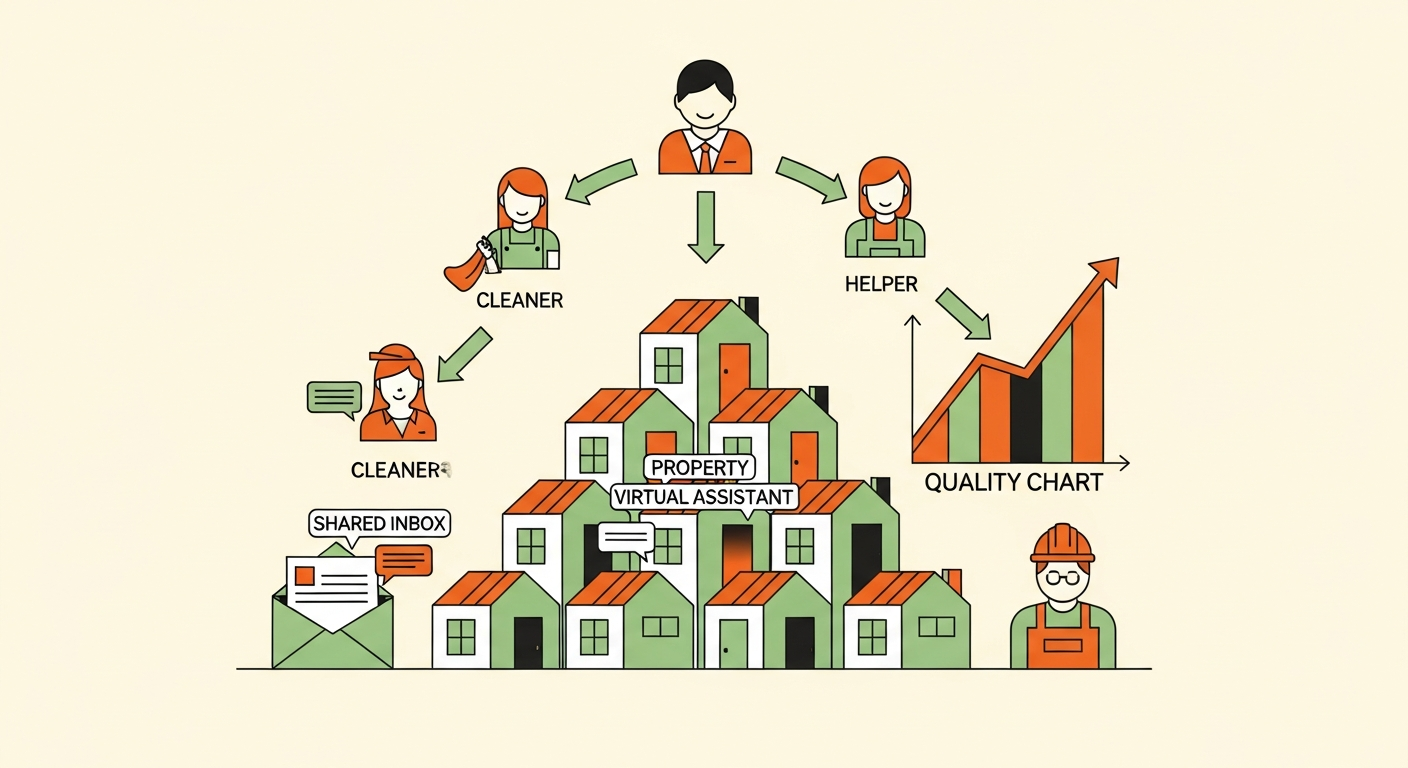
The same co-host who runs two or three properties flawlessly often can't maintain that quality at eight or ten without changing how they actually operate. That's not a failure of effort -- it's a structural limit, and pushing past it without changing the model is exactly how service degrades. This article covers what has to change as a co-hosting relationship or a co-host's client base grows: when to delegate, what systems become necessary, how pricing and service commitments should evolve, and the point where a co-host quietly becomes a small property management operation.
This is written for both sides -- an owner wondering how far their co-host relationship can stretch, and a co-host deciding whether to grow or stay small. Both have read the rates and agreement content; this is the scaling mechanics. Property-count thresholds throughout are general patterns based on typical operating models, not fixed rules, since real capacity varies with property complexity and the co-host's own systems.
Where Personal Handling Stops Working
A solo co-host handling everything personally -- every guest message, every cleaning coordination, every maintenance call -- has a real ceiling. It arrives sooner than most expect.
The specific symptoms of scaling past capacity without changing the model:
Slower guest response times. The first and most visible crack. Messages that got answered in minutes at three properties sit for hours at eight, because they now arrive concurrently across more properties. Since response time affects rankings and reviews, this degrades performance across the whole portfolio, not just the property that waited.
Missed maintenance coordination. A maintenance issue at one property slips because attention was on a guest issue at another. At small scale these rarely collide; at larger scale they collide constantly.
Inconsistent cleaning quality. Coordinating cleaners across more properties without a system means gaps -- a turnover missed, a standard not enforced, quality drifting property to property.
Delegation -- handing specific tasks to someone else -- typically becomes necessary somewhere around five or six properties for a solo co-host, though property complexity moves this. The instinct to keep handling everything personally past that point, because that personal touch is what made them good, is precisely what breaks the quality it's trying to protect.
What Systems Become Necessary at Scale
At two or three properties, a co-host can run on memory and a shared calendar. That stops working, and specific tooling has to replace informal habit.
Centralized guest communication. A unified inbox with templated, automated messaging for the predictable sequences (confirmation, check-in, checkout), so personal attention goes only to what's off-script. Without this, concurrent messaging is the first thing to break.
Task assignment and tracking. As soon as anyone else does work, you need a system that routes tasks, tracks completion, and flags gaps -- rather than the co-host being the human coordination layer for every cleaner and contractor. Co-hosting software tools built for this are what make delegation actually work instead of just moving the chaos around.
Documented standards. Co-host performance metrics and standard operating procedures that encode how things should be done, so quality doesn't depend on the co-host personally doing each task. This is what makes consistent quality survive delegation.
Portfolio visibility. A single view across all properties and clients, which at real scale means leaning on sharing economy asset management software rather than a spreadsheet that's become unmaintainable.
The through-line: informal systems that worked through personal attention have to become explicit systems that work through structure. That transition is the actual work of scaling.
Renegotiating Service Commitments as Volume Grows
Service-level expectations set at three properties may not survive at ten, and pretending otherwise sets up disappointment on both sides.
The honest move is renegotiating expectations explicitly as volume grows, rather than letting service quietly degrade against unchanged promises. If a co-host committed to a response time that's no longer realistic across a larger portfolio without added staff, that commitment needs revisiting -- either by adding capacity to maintain it, or by adjusting the commitment openly.
For owners, this is the signal to watch. If your co-host is taking on more clients, ask directly whether your service level holds. For co-hosts, proactively raising it protects the relationship better than hoping no one notices the slip -- because they will notice, and unaddressed degradation erodes trust faster than an honest conversation about capacity ever would.
How Pricing Should Evolve
Scaling changes the economics, and pricing has to move with it in one of two directions.
Volume discounts for owners. A co-host managing several properties for one owner has lower per-property overhead and may pass some of that on -- the standard rationale for a per-property discount at volume, covered in the Airbnb co-hosting rates guide.
Higher rates to fund a team. The direction co-hosts often miss. Maintaining quality at scale frequently requires hiring help, and that has to be funded -- which can mean holding rates firm, or even charging more for a genuinely higher-reliability service backed by a team and redundancy, rather than discounting into unsustainability.
These pull in opposite directions, and which applies depends on whether the co-host is competing on price or on reliability. The mistake is discounting for volume while simultaneously needing to fund a team to service that volume -- that's how a co-host scales into thinner and thinner margins until quality (or the business) collapses. Model the actual cost of servicing more properties well before agreeing to a volume discount, not after.
When a Co-Host Becomes a Management Operation
There's a point where a scaling co-host stops being an individual providing personal service and becomes, functionally, a small property management company -- with staff, systems, and clients rather than a hands-on personal relationship.
This transition involves real changes: hiring and managing people, formalizing operations, taking on the overhead and obligations of a small business, and shifting from doing the work to managing others doing it. It's a different job, and not every co-host wants it.
The significance for both sides: when a co-host makes this transition, the personal-attention advantage that distinguished them from a management company erodes. An owner who chose a co-host specifically for that personal touch may find they now have a small management operation -- at which point the honest comparison is the co-host vs property manager comparison, because the co-host has become one of the things being compared. Neither party should sleepwalk through this transition without acknowledging what's changed.
The Capacity Framework
General patterns for a solo co-host, heavily dependent on property complexity and systems:
| Property Count | What a Solo Co-Host Can Typically Handle | What's Usually Needed |
|---|---|---|
| 1-3 | Everything personally -- messaging, coordination, maintenance response | Shared calendar, informal systems |
| 4-6 | Most things personally, but strain begins | Messaging automation, documented standards, first delegation (often cleaning) |
| 7-10 | Only with systems and some delegation | Task assignment software, a virtual assistant or subcontractor, renegotiated commitments |
| 10+ | Only as a small operation with staff | Team, formalized operations -- effectively a management company |
Worked Scenario One: The Owner Adding a Fourth Property
An owner with three properties managed well by a solo co-host, considering adding a fourth.
The question isn't "will they take it." A co-host who's building their business will usually say yes -- turning down work feels costly. The question is whether they have the capacity to service a fourth without degrading the first three.
What to check before adding:
- Is current service holding, or already showing small cracks (slightly slower responses, minor things slipping)? - Does the co-host have systems, or are they running on personal attention that's near its ceiling? - Have they added other clients recently that already consumed their slack?
The read: if the co-host has systems and current service is genuinely strong, a fourth property is often fine -- four is still within solo range for a systematized co-host. If they're already handling everything personally and service shows early strain, adding a fourth degrades all four. In that case, either the co-host needs to add capacity first, or the owner should consider additional help for the new property rather than loading an already-stretched relationship.
The mistake owners make: adding properties to a co-host who says yes without checking whether yes was capacity or just reluctance to decline.
Worked Scenario Two: The Co-Host's First Hire
A co-host whose client base has grown to the point where they're stretched, deciding whether to hire their first assistant or subcontractor.
The tension: hiring adds cost and management overhead before it clearly pays off, while turning down clients feels like leaving money on the table. So co-hosts often do neither -- they take the clients and absorb the overload personally, which is exactly what degrades quality.
The decision framework:
- If quality is already slipping, you're past the hire point. The choice was made when you took the clients; the hire is now catching up to a decision already made. - What to delegate first: usually the high-volume, lower-judgment work. A virtual assistant handling guest messaging overflow (virtual co-host services exist specifically for this), or a subcontractor -- someone contracted to handle specific work -- taking cleaning coordination. Keep the judgment-heavy client-relationship work yourself initially. - Fund it properly: the new capacity has to be paid for by your pricing, which is why scaling and pricing decisions are the same decision.
The read: the instinct to say yes to every client is what causes the quality problems, because it commits you to volume before you've built capacity to service it. Saying yes to a client and then hiring to service them is fine. Saying yes and absorbing it personally is the trap. If growing the client base is the goal, a deliberate co-hosting client acquisition strategy paired with capacity planning beats reactively accepting whatever comes.
Common Mistakes on Both Sides
Owner: adding properties without checking capacity. Loading a fourth, fifth, or sixth property onto a co-host without confirming they can service it well, then being surprised when service across all properties dips.
Co-host: taking more clients than serviceable. Saying yes because declining feels costly, then degrading quality across the whole book. The costly thing is actually the reputation damage from stretched service, not the declined client.
Both: unclear communication about service changes. Not discussing how service level shifts as volume grows, so expectations and reality drift apart until something breaks the relationship.
Co-host: delegating without systems. Handing work to an assistant or subcontractor without documented standards or task tracking, so delegation just distributes the chaos instead of containing it.
Co-host: subcontracting without addressing the agreement. Bringing in another party to do the work can raise liability and agreement questions -- covered in the FAQ -- that need explicit handling, not assumption.
When Scaling Isn't the Right Move
Worth stating plainly: not every co-host should scale, and choosing not to is a legitimate business decision, not a failure of ambition.
A co-host who values the personal, hands-on relationship model -- who is genuinely good precisely because they handle everything themselves and know every property intimately -- may be better off staying small and selective than growing into a management operation they don't want to run. Scaling changes the job from doing the work to managing people doing the work, and that's a different profession that some of the best hands-on co-hosts would actively dislike.
Staying small and charging a premium for genuinely exceptional personal service is a viable, respectable model. The mistake isn't declining to scale -- it's scaling by default, taking on clients until the personal model breaks, and ending up as a mediocre management operation instead of an excellent boutique one. Choose the model deliberately.
Frequently Asked Questions
How many properties can one co-host handle?
Generally everything personally up to about three, with strain beginning around four to six and systems or delegation becoming necessary, and roughly ten as the point where they need a team and effectively become a small operation. These are patterns, not rules -- property complexity and the co-host's systems move the numbers substantially.
How should a co-host tell a client they're at capacity without losing the relationship?
Frame it as protecting quality, not declining work. "I'm at the capacity where I can maintain the service standard you're getting -- taking on more would mean it slips, which I'm not willing to do" positions the limit as commitment to their experience. Most owners respect a co-host who protects quality over one who overextends and degrades it. You can also offer a timeline for when you'll have capacity, or a referral, keeping the relationship warm.
Does subcontracting work to another co-host raise liability or agreement issues?
Yes, and it needs explicit handling. Bringing another party into the work can affect liability, insurance, and the terms of your existing agreement with the owner. The owner's agreement may require disclosure or consent for subcontracting, and liability for a subcontractor's errors needs to be addressed rather than assumed. Handle it in the co-hosting agreement legal template before subcontracting, not after something goes wrong.
Should I hire an employee or use subcontractors as I scale?
It depends on control and consistency needs. Subcontractors are more flexible and lower-commitment but offer less control over how work is done; employees offer more consistency but carry more overhead and obligation. Many scaling co-hosts start with subcontractors for specific functions (cleaning coordination) and move toward employees only as volume justifies the commitment. The classification also carries tax and legal consequences worth confirming with a professional.
How do I keep cleaning quality consistent across more properties?
Documented standards plus task tracking. The quality drift at scale comes from coordinating more cleaners without a system enforcing a consistent standard. Written procedures, completion tracking, and periodic quality checks are what hold consistency as you add properties -- personal oversight of every turnover doesn't scale, so the standard has to live in a system.
When does adding software actually become worth it for a co-host?
Around the point where you're delegating -- roughly five or six properties. Below that, informal systems work. Once anyone else is doing the work, task assignment and centralized messaging software are what make delegation function rather than just redistribute the coordination load. The software's value tracks the delegation decision, not raw property count.
Is it better to stay small or scale?
Neither is universally right -- it's a deliberate choice between two different businesses. Staying small preserves the personal, hands-on model and can command a premium for exceptional service. Scaling grows revenue but changes the job to managing people and systems. The mistake is scaling by default until the personal model breaks; choose consciously.
The Takeaway
Multi-property co-host scaling works only when the operating model changes with the volume -- the personal attention that makes a co-host excellent at three properties has to become explicit systems, delegation, and documented standards by eight or ten, or quality degrades across the whole portfolio. For owners, check capacity before adding properties rather than trusting a reflexive yes; for co-hosts, build capacity before accepting the volume that requires it, price to fund that capacity, and decide deliberately whether you actually want to become a management operation at all.