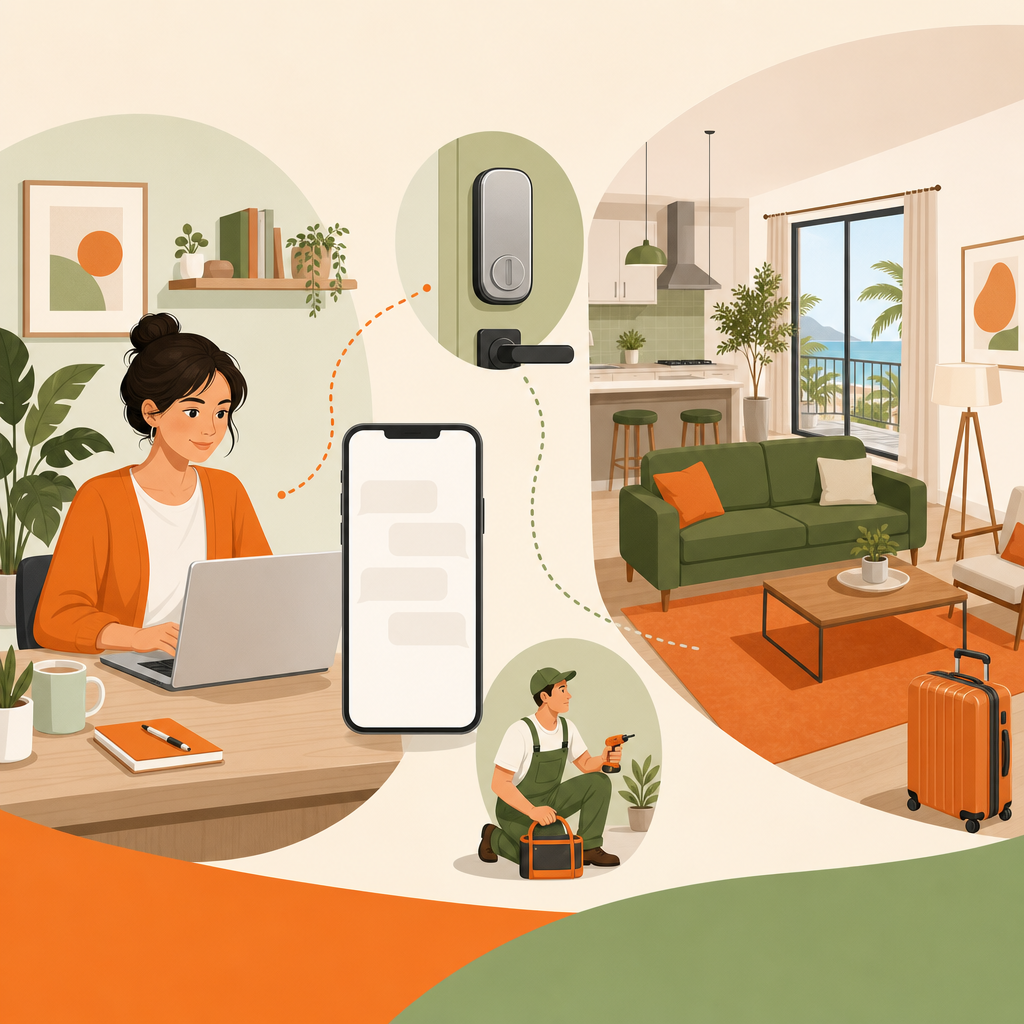
A virtual co-host handles everything that doesn't require being physically at the property -- guest messaging, booking coordination, pricing management, dispute mediation -- and handles it well. What they structurally cannot do is anything needing physical presence: a key handoff, an in-person issue, cleaning oversight. This is why nearly every successful virtual arrangement isn't purely virtual at all -- it pairs a virtual co-host with a separate local contact for the physical tasks. This article covers exactly where that task boundary sits, how to structure the hybrid, and when remote-only actually works versus when it fails.
This assumes you've read the rates and agreement content and want the specific remote-versus-local question answered. The honest answer isn't "virtual replaces local" or "local is non-negotiable" -- it's a hybrid, and the reasoning for landing there is what follows.
What's Genuinely Location-Independent
A large share of co-hosting is information work that doesn't care where the co-host sits. These tasks are well-suited to a fully virtual arrangement:
Guest communication. Answering inquiries, sending check-in instructions, handling questions and most issues, managing reviews. This is the largest chunk of ongoing co-hosting work by volume, and it's entirely location-independent -- a virtual co-host three time zones away answers a guest message exactly as well as one across town.
Calendar and pricing management. Monitoring the calendar, adjusting pricing, managing availability, coordinating bookings across platforms. Pure information work, ideally suited to remote handling.
Coordinating (not performing) local services. A virtual co-host can dispatch and coordinate a local cleaner or handyman -- notifying them of a turnover, scheduling a repair -- as long as that local person exists. The coordination is remote; the hands are local. This distinction is the entire key to the hybrid model.
Dispute mediation. Handling guest complaints, negotiating resolutions, managing the platform relationship. Communication work, location-independent.
The pattern: if a task is fundamentally about communication, information, or coordination, a virtual co-host handles it as well as a local one. That's genuinely most of the recurring workload, which is why virtual co-hosting is viable at all.
What Requires Local Presence
The rest of co-hosting needs someone physically there, and no amount of remote capability changes that:
Key handoff. Getting the guest into the property -- unless removed by technology, covered below.
In-person issue resolution. A broken appliance, a lockout, a heating failure, a guest emergency. Someone has to physically go.
Cleaning oversight. Confirming a turnover actually met standard, not just that the cleaner reported it done.
Physical inspections and maintenance. Periodic checks, damage assessment, anything requiring eyes and hands on the property.
Virtual co-hosts solve this gap two ways, and successful arrangements use both:
Technology to remove the need. A smart lock -- a keyless lock issuing codes remotely -- eliminates the key handoff entirely, letting a virtual co-host manage access without anyone physically present. This is the single most impactful piece of the virtual puzzle, since it converts the most frequent physical task (letting every guest in) into a remote one. A solid Airbnb self-check-in system setup is close to a prerequisite for virtual co-hosting.
A local contact for what's left. For the physical issues technology can't remove -- the broken appliance, the failed heater -- there has to be a local person: a cleaner who can also check on things, a handyman on call, a local partner. The virtual co-host coordinates them; they provide the hands.
The honest conclusion this forces: "virtual co-host" almost always means "virtual co-host plus smart locks plus a local contact." Pure virtual with no local path is where arrangements fail, covered below.
The Task-Allocation Table
Guest messaging. Yes. --. -- Pricing/calendar management. Yes. --. -- Booking coordination. Yes. --. -- Dispute mediation. Yes. --. -- Key handoff. With smart lock. Without smart lock. -- Cleaning coordination. Yes (dispatch). --. Coordination virtual, oversight local In-person issue resolution. --. Yes. Virtual triage, local execution Physical inspection. --. Yes. --
Read the table and the model designs itself: virtual handles the top cluster fully, technology converts the key handoff, and a local contact covers the bottom cluster while the virtual co-host coordinates it. The hybrid isn't a compromise -- it's the correct structure.
How Virtual Co-Host Pricing Compares
A common assumption is that virtual co-hosts charge less because their scope is narrower. The reality is more nuanced, and it comes down to what actually drives the workload.
The scope is narrower -- no physical presence, no on-the-ground work -- which pushes toward lower pricing than a full-service local co-host who handles everything including physical tasks.
But messaging volume is the real workload driver, and that doesn't shrink in a virtual arrangement. A virtual co-host handling all guest communication for a busy property is doing substantial work regardless of location. The volume of guest interaction, not the physical tasks, is often what determines how much effort the role actually takes.
The practical result: virtual co-hosting often costs less than full-service local co-hosting, but not always dramatically less, because the communication load -- the bulk of the work -- is the same. Where it clearly costs less is when you compare like-for-like scope: a virtual co-host doing messaging-and-coordination-only against a local co-host doing that plus physical tasks. But remember you're then paying separately for the local contact who covers the physical gap, so the true comparison is (virtual co-host + local contact) against (full-service local co-host). Sometimes the hybrid is cheaper; sometimes it isn't. The Airbnb co-hosting rates guide and the underlying co-hosting commission structure cover the rate ranges; the point here is to compare total cost of full coverage, not the virtual co-host's rate in isolation.
Tools and Communication Cadence That Make It Work
A virtual arrangement lives or dies on communication structure, because you can't lean on physical proximity to paper over gaps.
Response time commitments. A response time commitment is the agreed maximum time within which the co-host responds to a guest or to you. In a virtual arrangement this needs to be explicit and realistic, especially across time zones, because guests expect fast replies and there's no local presence to compensate for a slow one.
Escalation protocols. An escalation protocol is the predefined sequence for handling an issue that exceeds normal handling -- specifically, who gets contacted and how when something needs physical presence. This is the single most important piece of a virtual arrangement, because it's the bridge between the remote co-host and the local hands. A guest reports no hot water: the protocol defines that the virtual co-host triages it, then dispatches the named local contact, with a fallback if that contact is unreachable. Without this defined in advance, a physical issue hits a virtual co-host with no path to resolve it -- the exact failure mode covered below.
Shared tools. Everyone -- owner, virtual co-host, local contact -- working from the same systems: unified messaging, shared calendar, task tracking. Good co-hosting software tools are what let a distributed arrangement function as one coordinated operation rather than three disconnected people.
Defined roles in writing. Who handles what, and specifically who does what when a physical issue arises, documented in the co-hosting agreement legal template. Ambiguity about the physical-issue path is where virtual arrangements break.
Worked Scenario One: Virtual Co-Host Plus Local Cleaner
An owner with an established, reliable local cleaner, adding a virtual co-host for everything else.
The setup: the virtual co-host handles all guest messaging, pricing, and booking coordination remotely. A smart lock removes the key handoff. The existing local cleaner handles turnovers and -- by arrangement -- can also check on the property or handle minor physical issues when the virtual co-host dispatches them. The escalation protocol names the cleaner as the local contact for physical issues, with a backup handyman for anything beyond their scope.
Why it works: every task has a clear owner. Communication is remote and handled well; physical needs route to a real local person the owner already trusts; the smart lock eliminates the most frequent physical task. The virtual co-host coordinates; the cleaner executes; nothing falls into a gap.
The read: this is virtual co-hosting done right -- not virtual instead of local, but virtual plus a defined local path. The pre-existing reliable cleaner is what made it viable, since the physical gap had a ready answer. This is the model to aim for.
Worked Scenario Two: Where Pure Virtual Failed
The same owner, but no local contact -- just a virtual co-host and a smart lock, on the assumption that remote coverage plus keyless entry was enough.
What happened: a guest reported a significant issue mid-stay -- say, a failed air conditioner in summer heat. The virtual co-host responded to the message promptly and empathetically, exactly as designed. But there was nowhere to route it. No local contact, no dispatched handyman, no one who could physically go. The virtual co-host could apologize and communicate, but couldn't fix a physical problem from three time zones away.
The result: the issue went unresolved for the guest's stay because neither party had physical access or a local path. Fast messaging didn't matter -- the guest didn't need a fast reply, they needed someone to fix the AC. A poor review followed, citing not slow communication but an unresolved physical problem.
The lesson: guest experience depends on fast physical-issue resolution in addition to fast messaging, and a purely virtual arrangement with no local escalation path can deliver the second while completely failing the first. The gap wasn't the co-host's competence -- they handled their scope well. The gap was structural: no local hands existed. This is the failure mode that defines the boundary of what virtual-only can cover.
When Virtual Co-Hosting Makes the Most Sense
Virtual co-hosting is strongest in specific conditions:
You already have reliable local vendors. A trusted cleaner and handyman already in place means the physical gap has a ready answer, and a virtual co-host slots in cleanly for everything else. This is the ideal setup.
Low physical-issue frequency. A newer or well-maintained property, or a property type with fewer things to break, generates fewer physical issues, making the virtual model lower-risk. A property constantly needing physical attention strains any remote arrangement.
Smart-lock-compatible access. A property where keyless entry works well removes the most frequent physical task, which is foundational to the whole model.
Messaging-heavy, physical-light operations. Properties where the workload is dominated by guest communication rather than physical upkeep play to a virtual co-host's strengths.
In these conditions, virtual co-hosting (with its local pairing) is genuinely competitive with local co-hosting and sometimes preferable, since it widens the pool of co-hosts you can hire beyond your local area. If you're weighing this against handing everything to a management company, the co-host vs property manager comparison covers that broader choice.
Common Mistakes
Assuming a virtual co-host eliminates any need for a local contact. The central error, and the one that produces the failure scenario above. Virtual handles the remote work; something physical always remains, and it needs a local answer. Budget for both.
Unclear escalation protocols. Even with a local contact, an undefined path means an issue stalls while people figure out who's responsible in the moment -- exactly when speed matters. Define the physical-issue path in advance, in writing, with a fallback.
Underestimating physical-issue impact on guest experience. Fast messaging is necessary but not sufficient. Guests forgive a lot, but an unresolved physical problem during their stay produces bad reviews regardless of how well the co-host communicated. Physical resolution speed is a real quality driver, not an afterthought.
No fallback when the local contact is unavailable. A single local contact who's sick, traveling, or unreachable recreates the pure-virtual gap. The protocol needs a backup.
Treating time zones casually. A virtual co-host in a very different time zone may be asleep during your property's peak issue hours. Address this in the response time commitment explicitly rather than discovering it during a 2am guest emergency.
When Virtual Co-Hosting Isn't Viable at All
Be honest about the disqualifying case: a property in an area with no reliable local vendor network to pair with.
The entire hybrid model depends on there being local hands to route physical issues to. In a location where you can't find a dependable cleaner, handyman, or local contact -- a remote area, a market where reliable vendors are genuinely scarce -- the physical gap can't be adequately covered by anyone, virtual or otherwise. A virtual co-host in that situation is managing communication for a property whose physical problems have no resolution path, which is the failure scenario as a permanent condition rather than a one-time gap.
In that case, local presence isn't a preference -- it's a requirement, and the answer is a local co-host or a management company with its own local capacity, not a virtual arrangement. The viability of virtual co-hosting is ultimately capped by the availability of local support to pair it with, so assess that availability honestly before committing to a remote model. If the local network doesn't exist, no virtual arrangement fixes it.
Frequently Asked Questions
Can a virtual co-host fully replace a local one?
Not entirely, because some tasks require physical presence -- issue resolution, cleaning oversight, and key handoff without a smart lock. A virtual co-host replaces the communication, pricing, and coordination work fully, but the physical tasks need either technology (smart locks) or a local contact. The realistic model is virtual co-host plus local support, not virtual instead of local.
Do virtual co-hosts charge less than local ones?
Sometimes, but less than you'd expect, because messaging volume -- the bulk of the workload -- is the same regardless of location. The narrower scope (no physical tasks) pushes pricing down, but the communication load keeps it substantial. Compare total cost of full coverage: a virtual co-host plus a local contact against a full-service local co-host, since you're paying for the physical gap either way.
How do time zone differences affect a virtual co-host's response times?
Significantly, and this needs explicit attention. A co-host in a very different time zone may be unavailable during your property's peak issue hours, so the response time commitment has to account for it -- either by choosing a co-host in a compatible zone, arranging coverage across zones, or defining clearly what response times apply when. An unaddressed time zone gap is how a guest emergency hits during the co-host's night with no response.
What's the most important thing to get right in a virtual arrangement?
The escalation protocol for physical issues -- who gets dispatched, how, and with what fallback when something needs someone on-site. This is the bridge between the remote co-host and the local hands, and its absence is the single most common cause of virtual arrangements failing. Define it in writing before the first booking.
Does a smart lock make a virtual co-host fully sufficient on its own?
No, though it's foundational. A smart lock removes the key handoff -- the most frequent physical task -- which is essential to the model, but it doesn't address the other physical needs: a broken appliance, cleaning oversight, an emergency. You still need a local contact for those. The smart lock shrinks the physical gap substantially; it doesn't eliminate it.
Can I use a virtual co-host if I don't have a local cleaner already?
You can, but you'll need to establish a local contact as part of the setup rather than assuming the virtual co-host covers physical tasks. If you can find reliable local vendors, the model works once they're in place. If you genuinely can't find any local support in your area, virtual co-hosting isn't viable there, and you need local presence instead.
How is hiring a virtual co-host different from hiring a local one?
The vetting is similar -- the how to hire a co-host process applies to both -- but for a virtual co-host you're also assessing communication reliability across distance, time zone compatibility, and their experience coordinating remote arrangements with local contacts. And you're separately responsible for arranging the local support, which for a local co-host might be bundled into their service.
The Takeaway
Virtual co-host services genuinely cover the largest part of co-hosting -- guest communication, pricing, booking coordination, dispute mediation -- as well as any local co-host, but they can't perform the physical tasks that co-hosting also requires, so the working model is virtual co-host plus smart locks plus a defined local contact, not virtual alone. The make-or-break element is a clear escalation protocol routing physical issues to real local hands, because fast messaging without fast physical resolution still produces bad reviews. Assess your local vendor availability honestly before committing, since the whole model depends on having someone local to pair the remote coverage with.