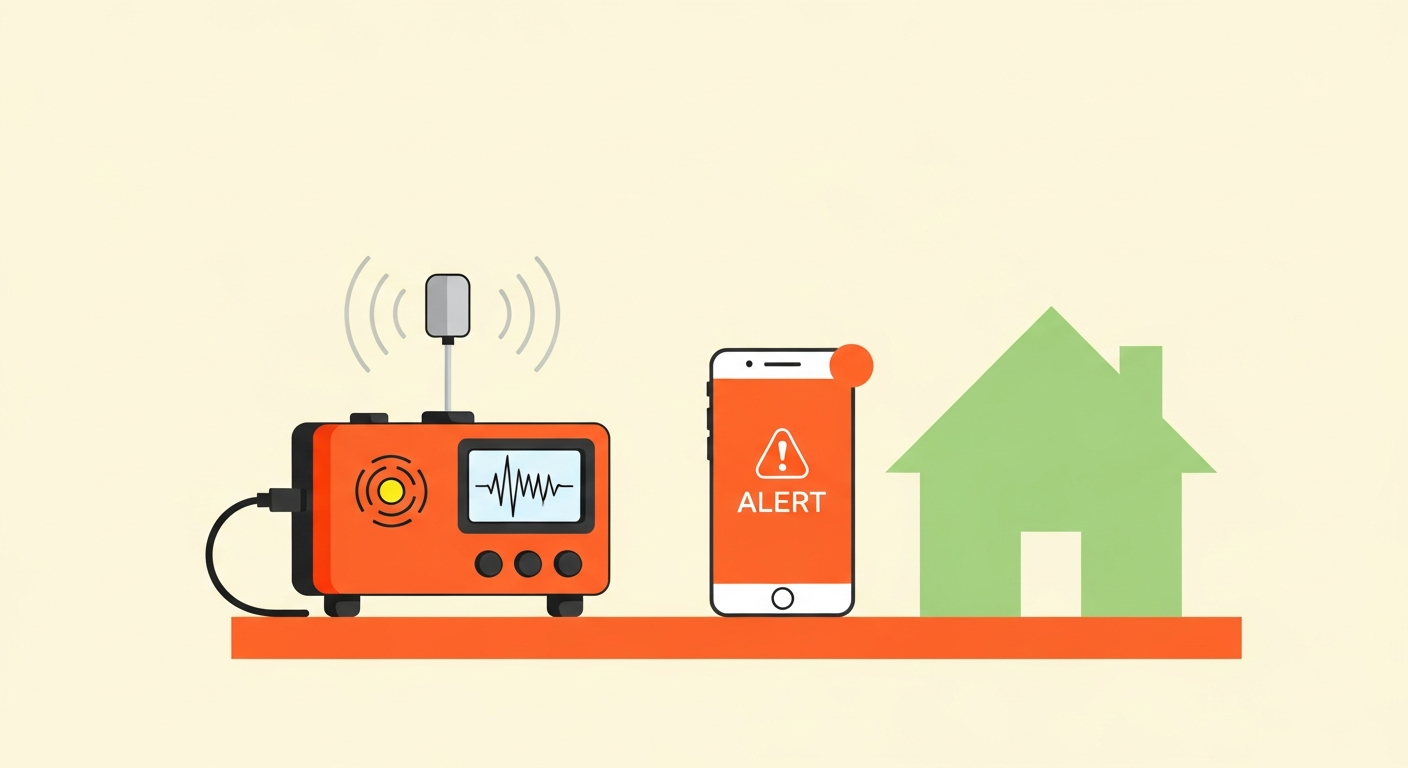
An Airbnb noise monitoring device measures sound levels -- decibels -- and alerts you when they cross a threshold. It does not record audio, and it does not capture video. That distinction is the single most misunderstood thing about this category, and getting it right matters both legally and for guest trust. This article covers how the technology actually works, how alerts translate into an operational response, and when deploying it across a portfolio is worth the cost.
|||
This assumes you already understand the compliance risk exists and want to prevent it operationally. Note that disclosure requirements and local noise ordinances vary by platform policy and jurisdiction, so confirm current rules rather than treating anything here as fixed.
|||
How the Technology Actually Works
|||
The device sits in the property and samples ambient sound level continuously. It measures volume -- decibel level -- against a decibel threshold you set: the sound level that, once sustained for a defined period, triggers an alert.
|||
What it captures is a number, not a recording. There is no audio stream, no conversation content, nothing a person could listen back to. Better devices measure sustained levels over a window rather than reacting to a single spike, which is what separates a device that alerts on a real problem from one that alerts every time someone drops a pan.
|||
Some devices also estimate occupancy from noise patterns -- inferring roughly how many people are present from the character of the sound, not from identifying anyone. Again: pattern analysis on sound levels, not recording.
|||
| What These Devices Typically Do | What Buyers Commonly Assume Incorrectly |
|---|---|
| Measure decibel levels against a set threshold | That they record audio |
| Alert the host when levels are sustained over the threshold | That they include video |
| Estimate rough occupancy from noise patterns | That they identify or track individual guests |
| Integrate with automated guest messaging | That they can hear or transcribe conversations |
| Log level history for evidence of compliance | That they're a surveillance device |
|||
The privacy-preserving design isn't incidental -- it's the entire reason these devices are permitted in interior spaces where a camera or microphone would not be.
|||
What Triggers an Alert and How to Respond
|||
An alert means a threshold was crossed and sustained. What happens next should be predetermined, not improvised at 1am.
|||
An escalation protocol is your defined sequence of responses at increasing severity. A typical one:
|||
- First alert: automated message to the guest, friendly and immediate. Most incidents end here -- guests usually aren't trying to cause a problem and simply didn't realize.
- Continued or repeat alert: direct personal contact from you.
- Sustained escalation: on-site response from a local contact, or the platform's involvement.
|||
The automated first step is what makes this scale. Wiring alerts into your messaging automation means a 1am threshold breach gets a polite nudge without waking you -- which is where this connects to the broader Airbnb host automation stack. Manually responding to every alert across five properties defeats the purpose.
|||
Set thresholds by property. A detached house in a quiet residential area and a unit in a dense building have genuinely different reasonable levels, and copying one threshold across a portfolio produces either false alarms or missed incidents.
|||
How This Fits Into Compliance Risk
|||
Here's what changes at multi-property scale, and it's the real argument for these devices.
|||
For a single-property host, a noise complaint is usually an unpleasant one-off. For a multi-property operator, complaints compound in ways that reach well past the incident itself:
|||
Permit and licensing risk. In jurisdictions where STR permits are conditional on not generating nuisance complaints, a pattern of incidents can threaten renewal -- and losing a permit costs vastly more than any single fine. This is one item on the short-term rental compliance checklist that can escalate from annoyance to existential.
|||
Fines that accumulate. Repeat violations often carry escalating penalties, and across a portfolio you're rolling the dice more often.
|||
Insurance implications. A pattern of complaints or incidents can affect coverage terms and rates, since it signals risk. STR insurance requirements by state cover how jurisdiction-specific requirements interact with this.
|||
Neighbor relationships. Underrated. Neighbors who file complaints also show up at zoning hearings when a city revisits its STR ordinance -- worth tracking alongside an STR zoning law tracker if your jurisdiction is actively revising rules.||| [B22] The asymmetry is what justifies the device: it's cheap, and the events it prevents are expensive and occasionally permanent. ||| [B23] ## Disclosing the Device Properly ||| [B24] Disclosure isn't optional in most cases -- platform policies and many jurisdictions require it, and requirements vary, so confirm what applies to you. Beyond compliance, disclosure done well is what prevents the review backlash that catches undisclosed hosts. ||| [B25] How to do it right: ||| [B26] - Disclose in the listing, clearly, before booking. A guest who books knowing about it has consented; one who discovers it has been surprised. - Explain what it does and doesn't do. "A noise monitor that measures sound levels only -- no audio or video recording" resolves the concern in one sentence. Most guest objections are to imagined surveillance, not to noise monitoring. - Frame it as neighbor consideration, which is honest and lands better than a rules-enforcement framing. - Include it in your house rules and welcome materials as part of the Airbnb guest experience checklist, so nothing feels concealed. ||| [B27] Guests almost never object to a disclosed noise monitor. They object, loudly and in reviews, to finding an undisclosed device. That's the entire difference. ||| [B28] ## Common Mistakes ||| [B29] Not disclosing it. The most damaging one. An undisclosed device discovered mid-stay produces exactly the guest reaction you'd expect, plus a potential platform policy violation. Disclose it and the problem evaporates. ||| [B30] Treating it as a substitute for clear house rules. A monitor detects a party in progress. Clear guest limits and party rules, stated upfront, prevent it from starting. The device is a backstop, not a policy -- and it works best paired with Airbnb guest screening automation that filters out the bookings most likely to become problems. ||| [B31] Choosing a device with a poor false-alarm rate. A monitor that alerts constantly gets ignored, which makes it worse than nothing. Look for sustained-level detection over a window rather than spike-triggering, and verify current specs against the vendor, since device capabilities change. ||| [B32] Setting one threshold portfolio-wide. Different properties need different levels. Tune per property. ||| [B33] No response plan. An alert with no escalation protocol behind it is just a notification that something bad is happening somewhere you aren't. ||| [B34] ## FAQ ||| [B35] Do noise monitoring devices record audio? No. They measure sound levels and alert on thresholds. There's no audio recording, no video, and nothing to listen back to. This privacy-preserving design is why they're permitted in interior spaces where a microphone or camera wouldn't be. ||| [B36] Do I have to tell guests about a noise monitor? In most cases yes -- platform policies and many jurisdictions require disclosure of monitoring devices. Requirements vary, so confirm what applies to your listings. Practically, disclosure also prevents the review backlash that undisclosed devices reliably generate. ||| [B37] Will guests be put off by a noise monitor? Rarely, when it's disclosed and explained. Most guests understand it and don't object once they know it doesn't record. The backlash comes from discovery, not from the device itself. ||| [B38] Are noise monitors worth it for a single property? It depends on your exposure. In a jurisdiction with real noise-related fines or permit conditions, or a property with a complaint history or strict HOA, the avoided-fine math works even at one property. In a low-risk setting the payback is slower -- the Airbnb smart home ROI calculator is the way to check rather than guessing. ||| [B39] What decibel threshold should I set? It depends on the property and its surroundings, so tune per property rather than applying one number everywhere. Start conservative, watch for false alarms in the first weeks, and adjust -- and check whether your local noise ordinance specifies levels or quiet hours you should align to. ||| [B40] ## The Takeaway ||| [B41] An Airbnb noise monitoring device is a cheap backstop against expensive, occasionally permanent outcomes -- fines, permit risk, insurance consequences -- and it works by measuring sound levels, not by recording anything. Disclose it clearly, tune thresholds per property, pair it with an automated escalation protocol and clear house rules, and it does its job without ever bothering a guest who wasn't going to be a problem anyway.